Something Is Missing From Your Room. You Already Know What It Is.
You have been in that room a hundred times. The proportions are right. The light is good. The furniture is considered, the objects on the shelves chosen with care. And still, every time you enter, there is a moment — brief, almost imperceptible — where something is not quite there yet. You feel the absence before you can name it. Then you adjust to the room, and the feeling passes, and you stop noticing.
That feeling is not imagination. It is accurate.
Rooms need a point of stillness. A place for the eye to rest, and then to return to, and then to explore. Without it, however carefully a space is arranged, something remains unresolved. The room does its job functionally but it does not breathe. It does not hold atmosphere. It is simply a collection of things that happen to share a wall.
What fine art photography does — when it is the right work in the right space — is provide that point of stillness. Not by being decorative. Not by matching the sofa. But by being a genuine presence. Something that has weight. Something that changes as the light in the room changes, that asks nothing of you and gives back more than you expected. Something you come back to.
This is what separates a considered work of fine art from everything else that gets hung on walls. A poster fills space. A reproduction is an echo of something that exists elsewhere. A limited edition original print — a physical, numbered, singular object — does something different. It belongs to the room it lives in, and only that room.
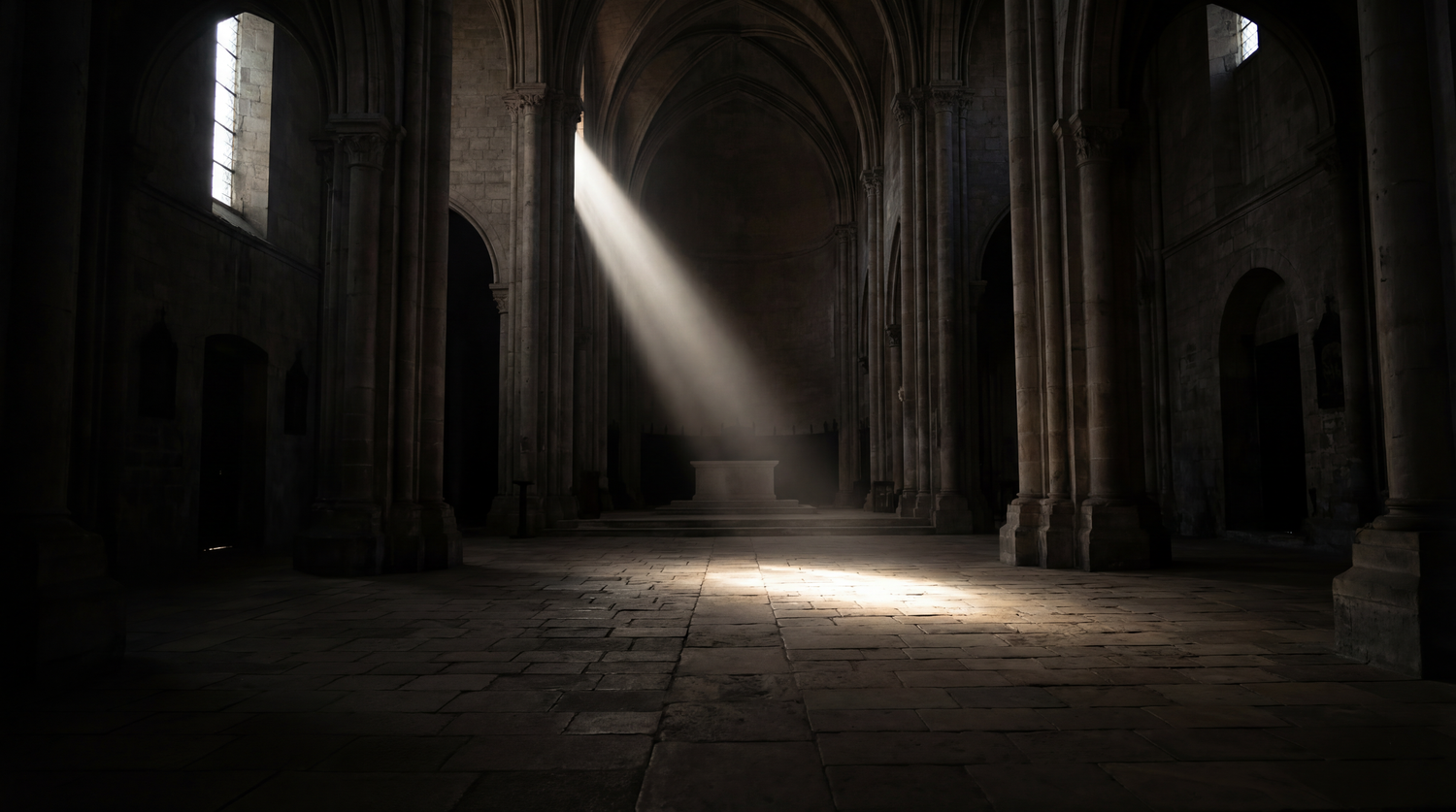
I photograph in silence. Ecclesiastical interiors, abandoned rooms, stone spaces where the light has been working on the same surfaces for three hundred years. These are environments where atmosphere is not manufactured — it accumulates. The air is different. The weight of time is in the walls. And the light, arriving at angles that have no equivalent in ordinary life, reveals textures and shadows that shift minute by minute as the sun moves.
My job in those spaces is simply to be present at the right moment. To read what the room is doing with its light and to hold it. Not to document, but to distil — to find the image within the atmosphere that carries the whole of what the space feels like when you are standing inside it alone.
That is what arrives on the wall when you acquire one of these works. Not a photograph of a building. A record of a moment within a building — which is something else entirely. For those who want to understand what draws me to these specific spaces, the thinking behind the church interior work is set out fully in why I photograph churches.
Scale matters more than most people expect. A print that is too small for its wall disappears. Not just visually — it loses authority. The space it was meant to anchor continues to feel unresolved. The right scale for a large room is almost always larger than feels immediately comfortable. A work printed at genuine size — something that commands its wall — stops being an object in a room and starts being a quality of the room itself. More on this in the piece on large wall art photography for living rooms, which looks specifically at how scale changes what an image does to a space.
Every edition I produce is limited to five. Not as a marketing decision — as a commitment. When I close an edition, it is closed. The image will not be reprinted. The five prints that exist are the only five that will ever exist. Each comes with a certificate of authenticity that carries my signature and the edition number, which belongs to that specific print and travels with it through every change of ownership.
This is the difference between collecting and decorating. A reproduction can be replaced. A limited edition print of five cannot. What you acquire is not a copy of an image — it is the image. One of five physical objects in the world that hold that particular moment of light in that particular space on that particular day. That is not a small thing. It is precisely the kind of thing that gives a room what it has been missing.
The material is cotton rag — Hahnemühle Photo Rag 300gsm — a surface that holds shadow with a depth that coated papers cannot match. No gloss, no reflectivity. The image lives within the paper rather than on top of it. At 36×24 inches, the difference is not subtle. It is immediately apparent to anyone who has lived with both. What ownership of this kind of work actually feels like over time — how the print changes as the room changes around it — is something I write about in detail in owning light, silence, and space.
There is also a question that serious collectors ask, and that I think everyone considering a purchase of this kind ought to ask: what is actually behind the image? How does it arrive at what it is? How many iterations does it take? What does it mean to refuse anything that is not right?
The honest answer is: the process is exacting, private, and entirely without compromise. The camera has always been a boundary. The eye sees something the lens cannot yet hold. I have spent a long time closing that gap — and Without Constraints is where I set out exactly what that means. It is worth reading before you decide. Not because it will convince you of anything, but because it tells you what you are actually acquiring when you acquire one of these prints — and that matters.
I am not a gallery. There is no middleman, no commission structure, no version of this work available somewhere else at a different price. You are buying directly from the person who made it. The edition size is five. The certificate is signed by me. The provenance is clean and traceable from the day the print is made to wherever it ends up.
The question of where to find work like this — what separates a genuine limited edition from the rest of the market, and why the distinction matters to anyone thinking about the long term — is addressed in full in where to buy fine art photography prints in the UK. And for those thinking about atmosphere and material and why certain prints hold a room when others do not, best fine art photography prints for interiors goes into all of that in detail.
The room you have been entering a hundred times — the one that is almost right — does not need more furniture. It does not need rearranging. It needs a point of stillness on the wall. Something with weight. Something that holds the light and gives the room somewhere for the eye to rest, and return to, and keep finding things in.
That is what I make. Five of them. Then it is gone.
Limited Edition Fine Art Prints
Edition of 1/3/5 · 36×24 cotton rag · Hahnemühle Photo Rag 300gsm · Signed certificate of authenticity · Direct from the artist