Collector Visualisation
The Living Space: A Study in Scale and Atmosphere
A sequence of interior visual studies exploring how selected works inhabit architectural space.
This page has been shaped for collectors, designers, and private clients who want to understand how a photographic work lives once it enters a real interior. Scale changes meaning. Light changes meaning. A room changes meaning.
These studies are intended to reveal not only proportion, but presence: the way a work settles into a setting, alters its atmosphere, and becomes part of the emotional rhythm of a place over time.
All works originate as original photographic captures and are produced as limited edition fine art prints on museum-grade materials. What matters here is not only the image itself, but the quiet relationship it forms with architecture, silence, and lived space.
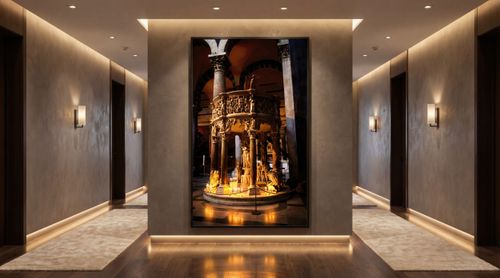
Environment I: The Sacred Gallery
Featured Work: The Vigils Grace
A study in stillness, proportion, and ceremonial quiet.
In this setting, the photograph is asked to hold a room without overwhelming it. The surrounding architecture remains gracious and restrained, allowing the work to act as a contemplative centre rather than a decorative interruption.
What emerges is a sense of quiet authority: the print draws the eye, but slowly. It does not announce itself. It gathers presence through tone, shadow, and the measured relationship between image and wall.
View the Sanctum of Shadows collection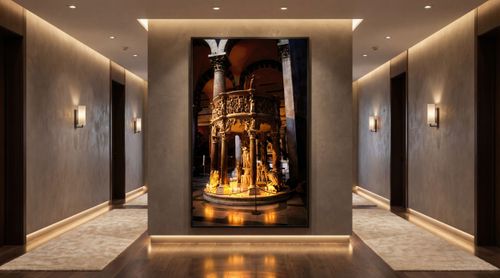
Environment II: The Grand Entryway
Featured Work: The Sacred Silence
Where first impression and atmosphere become inseparable.
Here the work performs differently. In a transitional architectural space such as an entryway, the photograph becomes an immediate emotional register for the home itself, setting tone before a word is spoken.
The image anchors the vertical scale of the room while deepening its sense of welcome, gravity, and composure. It suggests that a significant work can define not only a wall, but the threshold experience of the entire interior.
Explore The Candlelit Chamber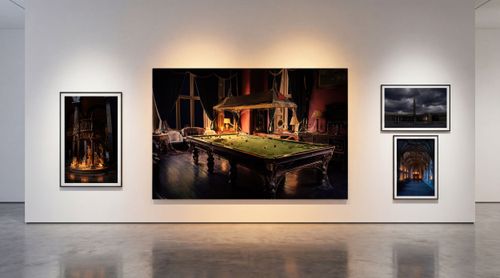
Environment III: The Drawing Room
Featured Work: The Long Game
A work of tension, patience, and long emotional afterglow.
In a more intimate domestic setting, the photograph becomes part of the room’s slower rhythm. It meets furniture, hearth, and material texture on equal terms, creating a dialogue between permanence and transience.
Rather than dominating the space, the work deepens it. This is often where collectors begin to understand that scale is not simply physical measurement, but emotional reach.
View Prints & Editions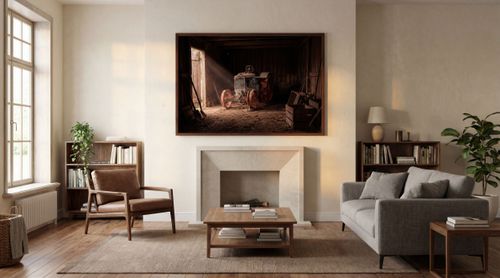
Environment IV: The Study
Featured Work: The Forgotten Machine
An industrial memory held within a reflective private room.
This placement brings a different energy. The image introduces history, endurance, and the weight of what has been left behind, yet within the context of a private study it becomes meditative rather than austere.
The visualisation demonstrates how more industrial or mechanical subject matter can still live elegantly within a refined interior when atmosphere, tonal control, and scale are properly balanced.
Discover Iron Without Witness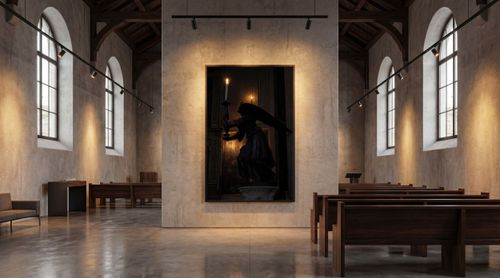
Environment V: The Quiet Chamber
Featured Work: Bearer of the Flame
A single work carrying heat, devotion, and interior gravity.
Some photographs hold a room through luminosity rather than scale alone. In this setting, the work becomes a source of symbolic warmth, gathering the surrounding space inward and intensifying the emotional tone of the interior.
For collectors, this kind of placement reveals how an image can function almost as a hearth element within a room: not merely seen, but felt as a centre of attention and atmosphere.
Read the artist statement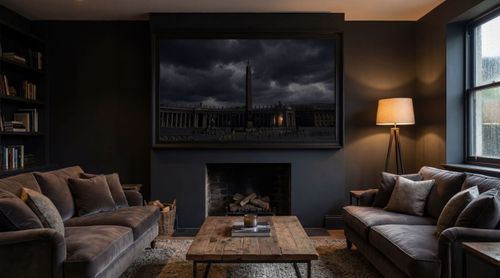
Environment VI: Architectural Hearth
Interior Visualisation Study
A final reflection on installation, belonging, and emotional permanence.
The purpose of these visual studies is not to simulate decoration, but to help a collector feel the moment when a work begins to belong. A successful installation does more than occupy a wall; it alters the emotional architecture of the room around it.
Seen in this way, collecting becomes a form of spatial authorship. The photograph is chosen not only for what it depicts, but for what it allows an interior to become.
Read about certificate of authenticityIf you would like to continue from these visual studies into the wider body of work, the most natural paths are into the collections, edition details, and the underlying philosophy that shapes the images themselves.
These visual studies are offered as a bridge between collection and installation, helping each work be understood not only as an editioned photograph, but as something that enters a life, a room, and a lasting atmosphere.