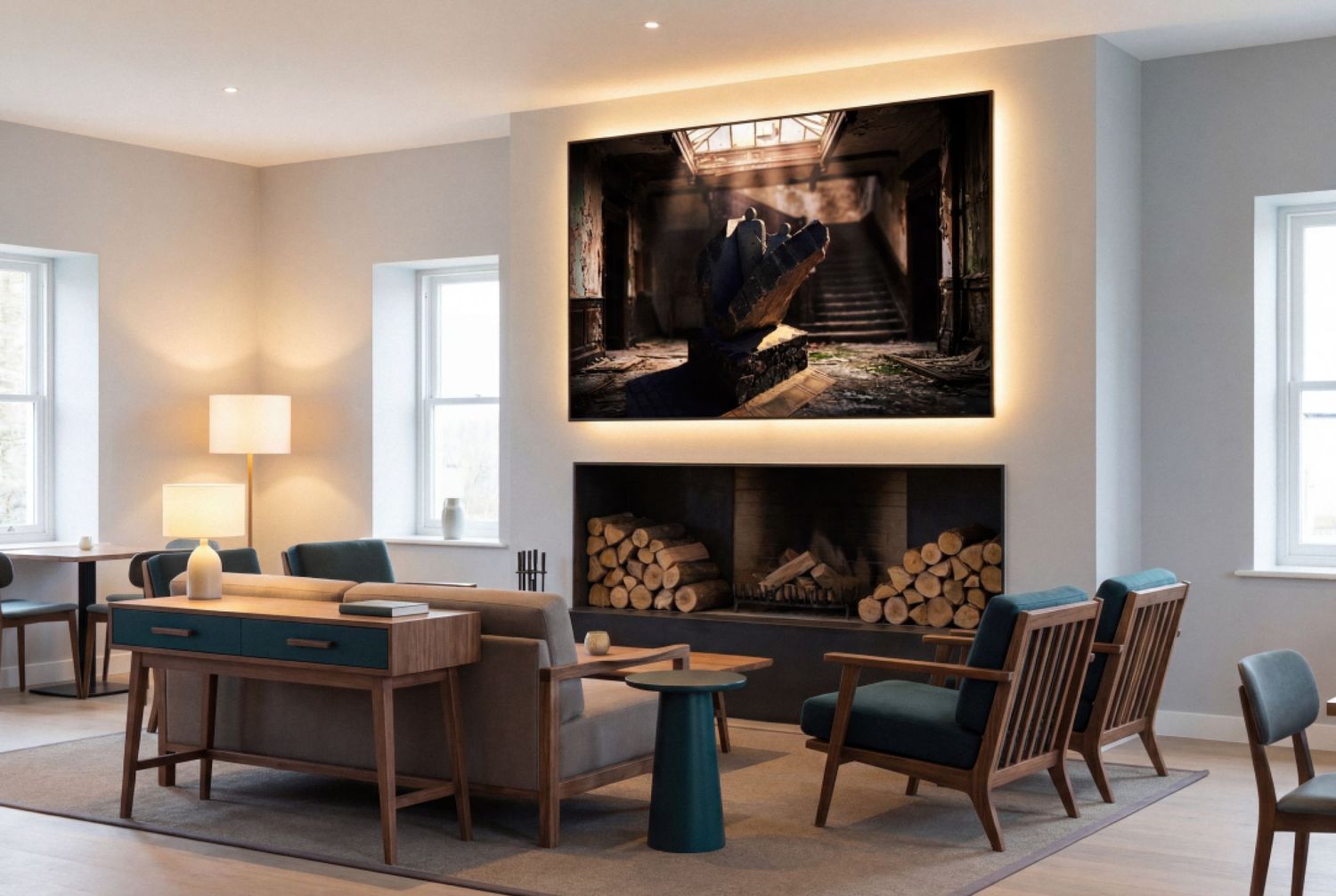
The Weight of Interior Silence: Why Empty Spaces Hold More Than Occupied Ones
Empty rooms remember. Not in any mystical sense — but materially, structurally, in the way a flagstone floor records every foot that has crossed it for three centuries, in the way a stone wall absorbs the particular damp of a winter that has been repeated hundreds of times. The room does not require the people to be present in order to carry what they left behind. If anything, it carries it more completely once they are gone.
This is the thing that draws me back, again and again, to spaces that have outlasted their purpose. A church no longer used for worship. A corridor that leads nowhere now. A room where the function has long since disappeared but the atmosphere — the particular combination of light, surface, proportion, and accumulated time — remains entirely intact. In these spaces, absence is not emptiness. It is weight.
The psychology of this is well understood, if rarely discussed directly. Enclosed spaces — particularly tall ones, with high ceilings and long sightlines — alter how the body responds before the mind has formed any conscious reaction. Breathing changes. Movement slows. The instinct to speak, if you are not alone, passes quickly. These spaces were often designed to produce exactly this effect — not as an accident of proportion, but as a deliberate intention. The cathedral architects understood what they were doing. The space was the instrument. The effect was the point.
What interests me photographically is what happens to that effect once the designed purpose has departed. A space built to induce reverence, now silent and unused, does not lose its capacity to induce it. In some cases it deepens. The reverence is no longer directed at anything specific — it becomes free, diffuse, available. The person standing inside the space brings their own history to it, and the space does not resist. It holds whatever is brought.
Light in these spaces behaves unlike anywhere else. It arrives at angles that have no equivalent in ordinary architecture — high, narrow windows designed to throw shafts rather than illuminate evenly; oculi that drop a single column of light onto a specific point in the floor at a specific hour of a specific season. The building is, in this sense, a light instrument. The stone is its medium. The shadow is as deliberate as the light that casts it.
This is what I am reading when I enter a space with a camera. Not the architecture as an aesthetic object, but the architecture as a light-management system that has been operating, largely unchanged, for centuries. The marks it leaves — the worn patches of floor where the light always falls, the bleaching on a south-facing wall, the darkening in a corner where no direct light ever reaches — these are the records of time that no document or photograph of people could produce. They require absence, and duration. They require the room to have been left alone long enough to tell its own story.
The wider thinking behind this — why silence in interior photography creates a different kind of emotional weight, and what that means for how these images function in a room — is something I explore at length in Silence, Interior Space and the Psychology of Stillness. The two pieces speak to each other directly.
Sometimes what carries the weight of a room is not the architecture itself but a single object left behind within it. A Decca radio on a dusty dresser, a crocheted doily beneath it, a candle burning beside it as if the broadcast is about to begin. The Last Broadcast is exactly this kind of image — a room stopped mid-sentence, every object holding its position long after the person who placed it there has gone. The empty space and the abandoned object are the same conversation, approached from different directions. It is the exact dynamic that dictates how candlelight redefines the architecture of a room.
A photograph made in this kind of space carries something of this with it when it leaves. Not the building itself — the building remains where it is, unchanged. But something of its quality of attention. The way it asked you to slow down, to read rather than scan, to find rather than be shown. A print hung in a domestic room brings that quality into the room with it. Not loudly. Not immediately. But over time, as the light changes and the work settles, the room begins to hold something it did not hold before.
This is what I think about when I consider why these images work at scale. A small print can carry the image but not the weight. Something printed at proper dimensions — at 36×24, on cotton rag, with the tonal depth that a matt surface gives to shadow — stops being a picture of a space and starts sharing some of that space’s quality with the room around it. The relationship between the work on the wall and the wall itself begins to feel like the relationship between the light shaft and the flagstone floor. One reveals the other. Neither is sufficient alone.
For those thinking about what this kind of work looks like in a domestic interior — how it behaves differently from decorative photography, what it does to a room that feels almost right but not quite — there is more in Something Is Missing From Your Room, which addresses that question directly.
And for those who want to understand the making — how these images are arrived at, what decisions go into the light and shadow, why the process is as exacting as it is — Without Constraints sets that out plainly. It is worth reading before you acquire, if the integrity of what is behind the image matters to you.
The spaces I photograph are not selected for drama. There is nothing spectacular about most of them at first encounter. They are quiet, often worn, sometimes barely holding together. What they have is time — the long, slow accumulation of it in surfaces and proportions that were built to last. That is the rarest material in photography. It cannot be manufactured or arranged. It can only be found, and waited for, and held.
That is what the print carries out of the space. Not the spectacle — the weight.
Limited Edition Fine Art Prints
Edition of 5 · 36×24 cotton rag · Hahnemühle Photo Rag 300gsm · Signed certificate of authenticity