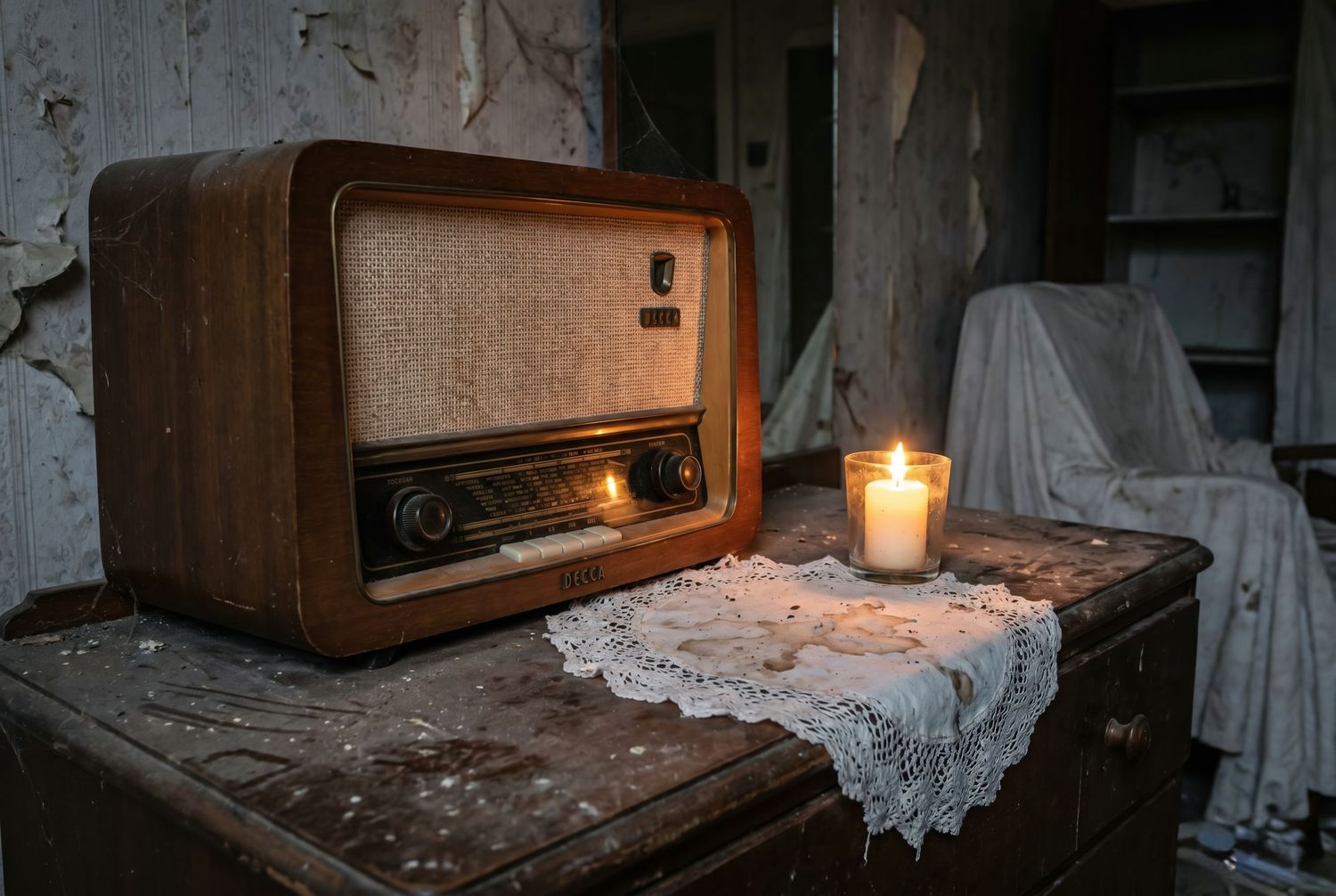
The Last Broadcast
Someone placed that doily there. Not carelessly — it was folded once, positioned, smoothed flat with a hand that thought about it. The radio was set on top of it with the same consideration. These were not accidental arrangements. They were acts of small domestic care, the kind that happens in a room where someone lives, where objects are tended and repositioned and tended again until the room becomes a record of the person who moved through it every day.
The room is abandoned now. The wallpaper has given up in long peeling strips. The chair in the background has been sheeted over — someone’s last gesture before leaving, a covering that has become its own kind of ghost. The dresser top is thick with dust and time. And yet the radio sits exactly where it was placed. The doily, stained and fragile, is still beneath it. The candle — someone’s candle, not mine — burns in its glass beside it, as if the broadcast is about to begin.
This is what draws me to these spaces and these objects, again and again. Not the ruin itself — ruin for its own sake holds nothing for me. What holds me is the evidence of the life that preceded it. The Decca radio is a beautifully made thing — walnut veneer, Bakelite controls, the station names still legible on the frequency dial. Hilversum. Athlone. Luxembourg. It was listened to. Someone sat near it in the evenings and heard voices come out of it, music, the news, the world made audible in a room that is now completely silent.
I photograph these objects because they remember in a way that photographs of people rarely can. A portrait shows you a face at a single moment. An object shows you a relationship over time — the handling, the placing, the decision to keep it. Every scratch on that dresser is a record. Every watermark on the doily is a record. The radio dial set to a particular station is a record of where it was last heard, which is to say a record of the last ordinary evening in that room before everything stopped.
One of the things I am most often told about images like this is that people keep finding things in them. They look once and see the radio. They look again and notice the cobweb in the upper left corner of the frame. They look a third time and see the reflection in the dark mirror glass behind the set — the faint ghost of the room reversed. A fourth time and they are reading the station names on the dial. A fifth and they are looking at the lace pattern in the doily, the stain that has spread through it, wondering what spilled there and how long ago.
This is not an accident of composition. It is the consequence of subject matter that has its own density. A room that has accumulated years has more in it than can be taken in at a single looking. The image holds what the room held — layered, slow to reveal, demanding a kind of attention that the ordinary pace of looking rarely allows. This is something I explore directly in The Discipline of Looking Slowly — why certain images only begin to give themselves up when you stop trying to read them quickly.
The candle is the thing that makes this image breathe. Without it, the scene would be a document — interesting, atmospheric, but closed. The flame opens it. It introduces time — not frozen time but moving time, the slow consumption of the wax, the slight movement of the light across the radio’s surface, the warmth it brings to the wood veneer against the cold grey of the peeling room beyond. The candle says: something is still happening here. Not everything has stopped.
That tension — between what has been abandoned and what persists — is the territory I keep returning to. It appears in the bronze hand holding the iron key in The Key Holder. It appears in the industrial machinery of Iron Without Witness, where the equipment has outlasted the industry that built it. It appears wherever an object has held its position long after the person who placed it there has gone. The object does not grieve. It simply remains. That is what I photograph — the remaining.
Memory works like this too, I think. Not as a single fixed image but as something you return to and find changed — not because it has changed, but because you have. The same memory visited at forty and at sixty yields different things. The same image looked at in the morning and at night, under different light, in different moods, gives back something different each time. It is not the image that moves. It is the attention brought to it.
That is precisely why images like The Last Broadcast work as objects in rooms rather than files on screens. On a screen, the eye moves on. There is always something next. On a wall, at proper scale — on cotton rag, with the tonal depth that surface gives to shadow and candlelight — the image stays. And so does the attention, returning to it on an ordinary Tuesday morning and finding the cobweb again, or the reflection, or the station name on the dial, and stopping for a moment in a room where someone else once stopped and listened.
This kind of work — objects that hold memory, rooms that accumulate time, the atmosphere of things that have outlasted their purpose — sits at the heart of The Relics Collection. And the wider thinking behind why these spaces and objects hold what they hold is explored in The Weight of Interior Silence — on what empty rooms carry, and why absence deepens rather than diminishes the atmosphere of a space.
The Last Broadcast is available now as a limited edition framed cotton rag print — one of five. The edition will not be reprinted once it closes.
The Last Broadcast
Limited Edition of 5 · Framed cotton rag fine art print · Signed certificate of authenticity