The Muniment Room Corridor
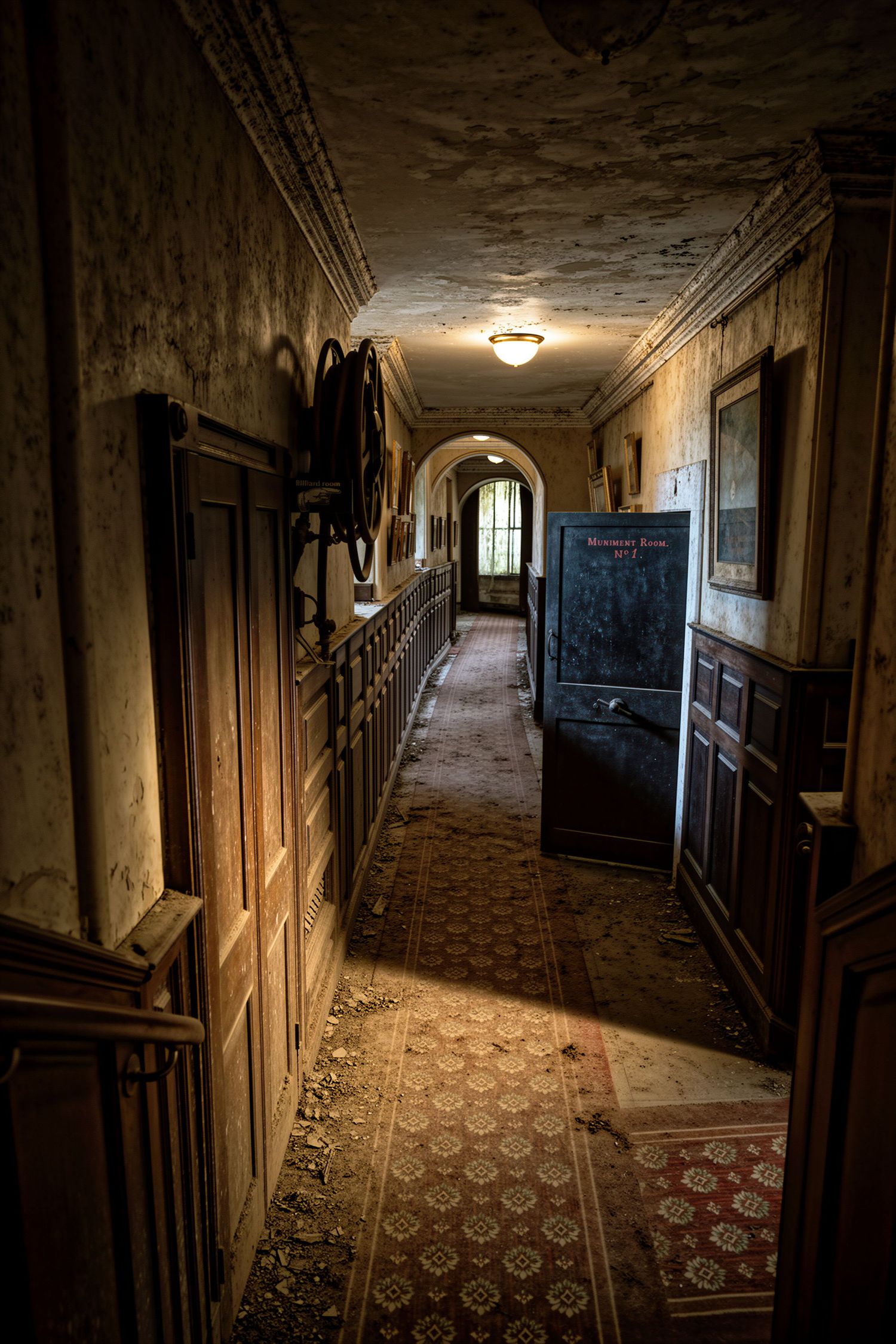
A painted hand still points the way to the billiard room.
It has been pointing for a very long time. Past the coiled fire hose on its iron wheel, past the pictures leaning against the panelling as though someone began taking them down and lost heart halfway, past the runner carpet now carrying more fallen plaster than footsteps. The hand does not know that no one is coming. Signs never do. They keep their small promises to an empty house.
But it was the black door that stopped me. Heavy as a safe, lettered in faded red: Muniment Room. No. 1. A muniment room is where a great house kept its proof — the deeds, the charters, the marriage settlements, the record of every hand the estate ever passed through. Every other room in this building held life. This one held the evidence of it. And it is the only door in the corridor built to survive what the rest of the house could not.
I knew the smell before I understood the room. I was thirteen the first time I breathed air like this, inside a derelict manor near where I grew up — that particular dampness of mould working slowly through horsehair plaster, cold even in summer, a smell that settles into the back of the throat and stays there for hours after you leave. Forty years on, standing in this corridor, it reached me before the camera did. Some part of me was thirteen again, listening for floorboards that could no longer be trusted.
The light asked for nothing. One brass ceiling lamp, still burning somehow, and at the far end an arched window gone green where the garden has begun pressing its way inside. Between the two, the corridor holds its breath. I stood where the lamplight fell across the carpet's faded pattern and waited until the shadow line sat exactly where the corridor turns from the known toward the unknowable. Then I raised the camera. Once.
I have written before about what waits behind the locked door — the way a sealed room exerts more pull than an open one ever could. And about how buildings become memory, how a structure absorbs the lives passed through it until the two cannot be separated. This corridor is where both ideas meet. The house is forgetting itself, wall by wall — and yet its entire memory sits intact behind one iron door, waiting for someone to ask.
On a wall, this photograph does not announce itself. It settles into a room the way dusk does — gradually, then completely. The pointing hand, the leaning frames, the red lettering on the black door: these reveal themselves across weeks of living with it, each one a question the image declines to answer. It is work that rewards the second look, and the fiftieth.
If you want to understand why I walk into places like this at all, I have tried to answer that in What Draws Me There. The shortest version is this corridor.
There is a thing I do in old cemeteries, taught to me years ago by someone I have never forgotten: I read the names on the headstones aloud, because it may be the only time in years those names are spoken. In this corridor I could not do it. The names are all behind the iron door — written in ink on parchment, folded into deed boxes, sealed against fire and time by people who believed remembering mattered enough to armour it. I stood in the mould-damp silence with my hand flat against the cold metal, and for once I had to leave the names unsaid. This photograph is the closest I could come to speaking them.
The Muniment Room Corridor
Printed on premium cotton rag · Shipped worldwide · Issued with a certificate of authenticity