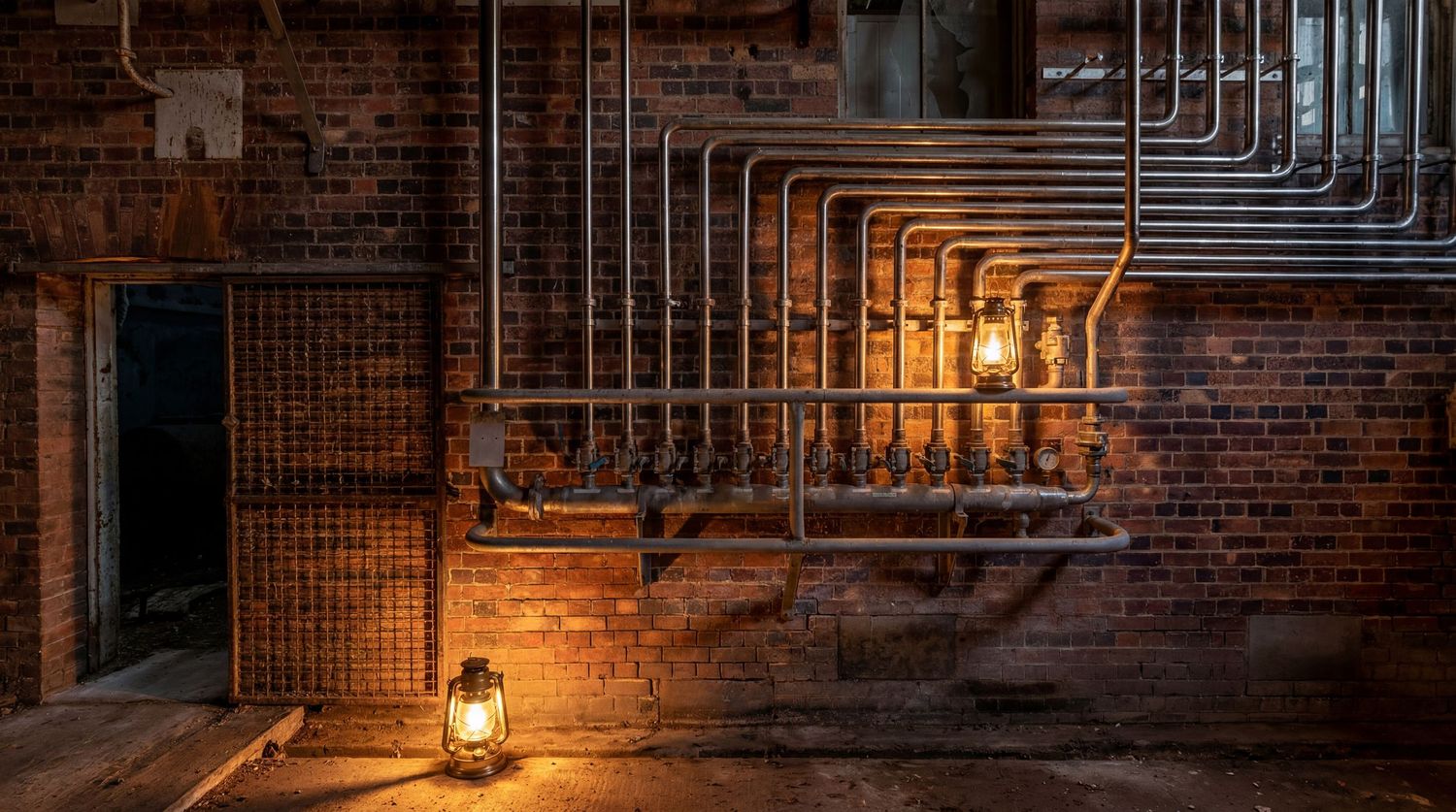
How Buildings Become Memory
There is a house I walked past every morning for three years. A terrace. Bay windows. A gate that never quite closed. I couldn't tell you what colour it was. I couldn't tell you what was behind the glass. But I can tell you exactly how it smelled in October — something between wet stone and coal smoke, and the faint sweetness of someone's cooking drifting out through a gap above the sash. I can tell you the sound the gate made. I can tell you the exact quality of light on that front step at half past eight on a winter morning, when the frost was still on the iron railing and the sky hadn't properly decided what it was going to be yet. I remember all of that without trying. The building itself is just the address. The memory is everything around it.
This is what I've come to understand after thirty years of photographing the places most people walk past: buildings don't store information. They store feeling. They store the accumulated weight of everything that happened inside them and around them and against their walls. And long after the people are gone, the feeling lingers. Not as a ghost. As a grammar. A set of rules about how the light falls in a particular room at a particular time of day. The angle of a door left open. The way silence sounds different in a room where people once laughed.
I've stood inside spaces that have been empty for decades — rooms where the wallpaper has come away in long slow strips, where a chair sits facing a window that no longer has glass, where the floor has softened and begun to return to the earth beneath it — and felt something I can only describe as recognition. Not of the building. Of the life that shaped it. The wear on a doorstep that tells you exactly where the weight always fell. The groove in a windowsill where someone rested their arm, summer after summer, looking out. These are not decorative details. They are the record of a human body, living.
A building is not just a container. It is a record. Every room a chapter. Every worn threshold a sentence that refuses to end.
I think about this particularly when I'm working on images for The Forgotten Room — a body of work that keeps returning to domestic space long after the domestic has departed. There is a particular quality to a room that has been lived in and then abandoned that you don't find in a room that was simply never occupied. The empty new room is a blank. The abandoned room is a palimpsest — layer upon layer, each one still faintly legible beneath the next. You can feel the Saturday mornings in it. You can feel the argument that was never finished. You can feel the particular exhaustion of a winter that didn't end when it should have.
What I am trying to do, when I photograph these places, is not to record their decay. Decay is incidental. What I am trying to hold is the moment before the feeling goes — that interval in which the room still knows what it was, even if no one is coming back. That trace is the subject of almost everything I make. Not the object. The impression the object left behind. Not the person. The shape of where they stood.
There is a reason we say a building has character. We mean it has survived enough to become itself — shaped by weather and use and time into something that could not have been designed. You can build a new house and fill it with antique furniture and it will still feel like a new house. Character cannot be installed. It accumulates. It requires the friction of actual living against actual walls. It requires children running their hands along the banister until the wood goes dark. It requires the particular angle of afternoon light that fell on a specific chair for forty years until the fabric bleached in a shape that exactly fits a body no longer there.
I have spent a long time thinking about why this matters to me photographically. I think it comes down to something very simple: I don't trust the present. Not because it isn't real, but because it hasn't been tested yet. The buildings I am drawn to have been tested. They have endured winter. They have endured loss. They have stood while the people who built them and loved them and left them went somewhere else entirely. And they are still standing. That strikes me as worth attention. That strikes me as worth the time it takes to be still inside a space until you understand what it is trying to say.
The making of silence visible is always a slow act. You cannot rush it. You cannot arrive at a place and immediately know it. You have to let your eyes stop looking and start receiving. You have to stop reading the surfaces and start feeling what is behind them. This is as true of buildings as it is of people. The face a building shows you when you first arrive is not the face it shows you after an hour. An hour is rarely enough.
Memory is not stored in the mind alone. Some of it is stored in the grain of a door, the sag of a sill, the particular darkness of a corner that never got the light.
I remember the first time this became undeniable to me. I was inside a mill — the kind of stone building that had been standing for two hundred years before anyone thought to abandon it. It had been decades since any grain moved through it. The belts were long rotted. The millstones sat as they were left, mid-turn, as if someone had simply walked away mid-morning and not returned. What I remember most is the smell — and the strange thing about it was that the smell felt warm. Not warm like temperature. Warm like something that had once been alive and hadn't entirely forgotten how. The light was the same — that particular quality you find in abandoned spaces where the light still comes in but has nothing left to fall on. Warm and empty at the same time. Beautiful in a way that made no obvious sense. I stood there for a long time. Not photographing. Just letting it arrive. And what arrived was not sadness exactly — though sadness was in it — but something more like an invitation. As if the silence of the place was not asking you to leave but asking you to stay. To sit with it. To understand that this was not emptiness. This was a room still full of everything that had happened in it, waiting for someone to be still enough to feel it.
That encounter sits beneath a great deal of Iron Without Witness — the ongoing work with industrial space and the particular silence of machinery at rest. But it also sits beneath everything else I make, even the quietest interior, even the most domestic room. The question is always the same: what did this space hold? What is it still holding? What will be lost when it is finally gone?
We tend to think of memory as personal. Yours, mine. Locked behind the eyes. But I have come to believe that certain buildings carry something collective — a residue of shared human experience that doesn't belong to any one person, that waits in the plaster and the floorboards and the particular quality of shadow that falls across a threshold at four in the afternoon in November. Some of what we feel when we enter these spaces is recognition without cause. A knowledge that something happened here, even if we cannot say what. Even if no one living can say what.
This is not mysticism. It is physics, of a kind. Every building is also a record of the forces exerted upon it — weather, use, time, neglect. A wall that leans slightly has leaned for a reason. A floor that dips has dipped under the weight of something. The building registers. It has no choice. And what it registers, it keeps. Long after the people are gone. Long after anyone can translate what it means.
What I am doing, when I photograph these places, is trying to translate. Not to explain — I have no interest in explaining. But to hold the feeling long enough for someone else to enter it. To make an image that sits in a room and gives that room back its weight. Its history. The sense that something was here, and mattered, and is now only present in the quality of the light across a particular surface at a particular hour.
That is what buildings become, eventually. Not ruins. Not heritage. Memory — specific, sensory, almost entirely beyond words. Almost.