How to Light Silent Interiors — And the Psychology of Space
A space is never truly empty. That is the first thing I learned, and the thing I keep relearning every time I walk into a room that has been left to time.
There is a particular atmosphere that collects in places no longer lived in. Not absence — something closer to the echo of presence. A chair positioned toward a window. Plaster that has given up in one corner and held firm in another. Light arriving at an angle no one planned for, pooling on a floor that once carried footsteps. These rooms are not dead. They are waiting. And the photographer’s task — as I understand it — is not to document that state but to honour it.
The question of how to light these spaces has occupied me for thirty years. Not the technical question. The human one. What does a room feel, and how do you make a viewer feel it too?
The Psychology Comes First
Before I raise a camera, I sit. Sometimes for twenty minutes. Sometimes longer. I let the room settle around me, and I let myself settle into it. This is not sentimentality — it is method. That process is central to my creative process: arriving with technique and then setting it aside long enough to listen. A space has a psychological weight. High ceilings create a particular kind of awe that sits very differently from the compression of a low-vaulted cellar. A long corridor implies journey, inevitability, passage from one state to another. A single broken window frames what lies beyond it like a painting chosen by no one.
Environmental psychology has a name for this: affordance. The idea that space communicates possibility and invitation through its physical form. But photographers working in abandoned or historic interiors know something that clinical language struggles to hold — that these places communicate more than function. They communicate grief, and labour, and the particular dignity of things that were once cared for and no longer are.
I think about what the room wants to say. Then I think about how light can serve that sentence.
Light in a silent interior is not decoration. It is the difference between a room that is seen and a room that is felt.
Working with What the Room Already Has
My preference — almost always — is available light. Not because I am philosophically opposed to additional sources, but because available light in a forgotten interior already knows the room. It arrives through the gaps time has made. It falls on the surfaces time has changed. To bring in artificial light and flood the space is to lose the very thing that drew you there.
I work predominantly with window light, and with candlelight when I want to pull something from the dark. Both have a warmth and directionality that flatware flash cannot replicate. Window light in a derelict space is rarely clean — it picks up the dust in the air, it bounces off stained walls, it arrives already coloured by what it has passed through. That is not a problem to solve. That is the atmosphere. Work with it.
The key is understanding where the light falls and, more importantly, where it refuses to go. Shadow is not a failure of exposure. In my work across the Architecture of Silence and the Sociology of Shadows collections, shadow is where the meaning lives. What is withheld from the viewer is as deliberate as what is offered. A partially lit doorway. A face half-consumed by dark. A stone floor where the light ends abruptly and the room simply… continues.
Candlelight as Instrument
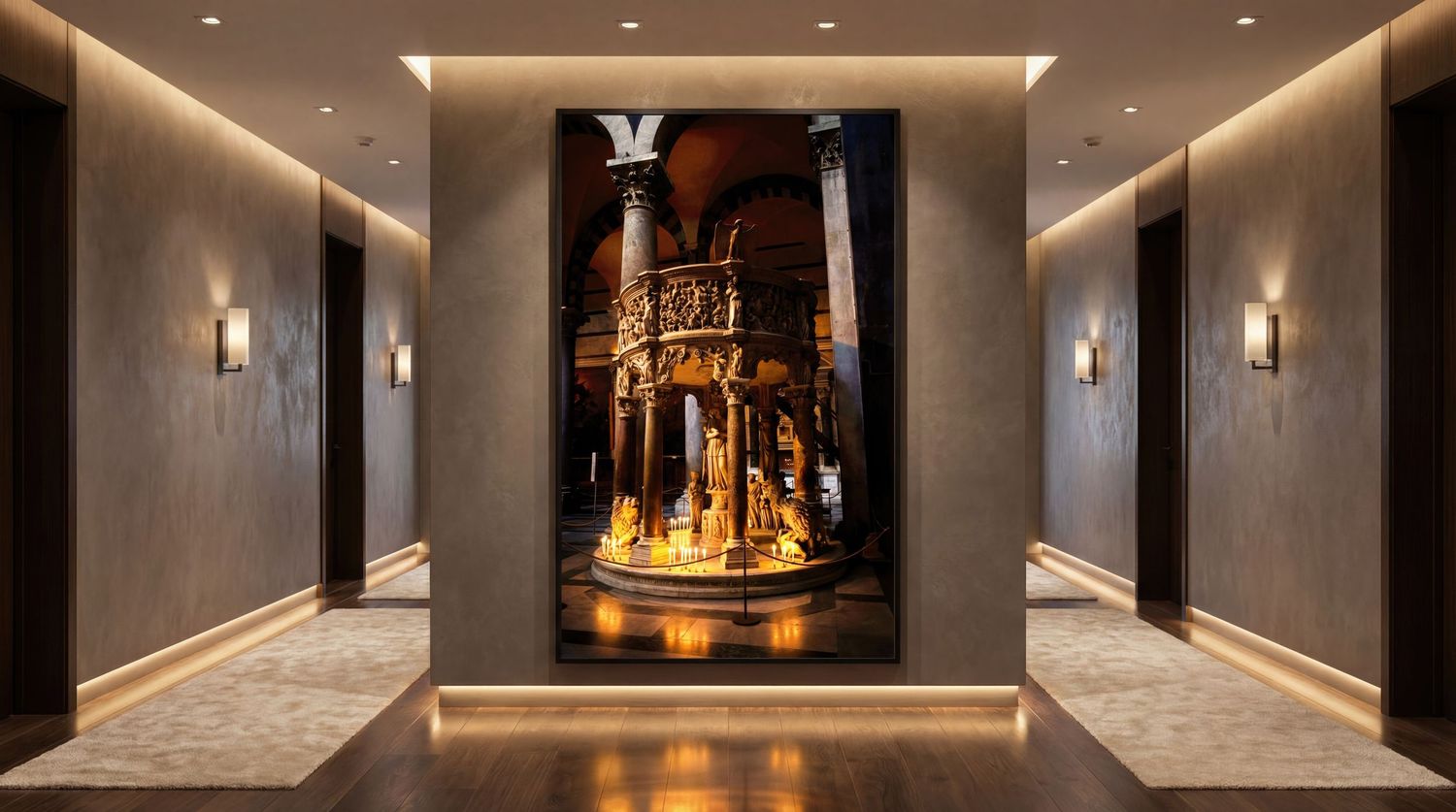
When I photograph by candlelight — as I do throughout the Candlelight Antiquity series — the flame becomes a collaborator. It is unstable. It moves. It changes the temperature of the scene from moment to moment, casting warm gold across cold marble, then retreating. You cannot fully control it, which is precisely why it produces images that feel alive in a way that controlled studio light rarely achieves.
Candlelight does something that photographers often forget to consider: it creates a centre of gravity. The eye is drawn first to the flame’s influence — the brightest region — and then travels outward into darkness. This is chiaroscuro in its most literal form, the same principle that guided Caravaggio, that gave Rembrandt his extraordinary sense of interior life. The painting technique and the photographic instinct are not so different. Both ask: where does the light come from, and what does it reveal on its way through the dark?
Practically, working by candlelight demands patience and a willingness to shoot at high ISO — though with the DxO PhotoLab DeepPRIME processing I use with the Panasonic DC-S5M2X, noise ceases to be an obstacle and becomes instead a texture, a grain that suits the age and atmosphere of the subject. I rarely fight the noise. I let it become part of the image’s skin.
Shadow is not a failure of exposure. It is where the meaning lives. What is withheld from the viewer is as deliberate as what is offered.
Composing for Emotional Weight
Lighting and composition in silent interiors are inseparable. Where you place the camera determines which shadows fall within the frame and which do not. I tend toward wide apertures — the 35mm f/1.8 is my primary lens for interior work — because the shallow depth of field creates a softness at the edges of the frame that mirrors the way memory works. The thing in focus is what you are being asked to hold. Everything else is feeling.
I also think carefully about negative space. In a busy world, negative space is countercultural. A large area of dark in a photograph makes many people uncomfortable. It feels unfinished, under-exposed, somehow wrong. But in a silent interior, that darkness is the room breathing. It is the space the subject exists inside, and it matters as much as the subject itself. I want the viewer to lean forward slightly, to search the dark without quite finding what they are looking for. That state of searching, of attention held open — that is what the discipline of looking slowly makes possible, and the experience I am trying to create.
What the Space Is Asking Of You
There is a tendency in photography to approach a space with a plan. A lighting diagram. A shot list. I understand the impulse and I do not entirely dismiss it — but for this kind of work, too much intention closes the eye before it has had a chance to see. The best images I have made in silent interiors came from moments I did not anticipate. A change in cloud cover that sent a bar of light across a particular wall. A candle catching a draught and throwing a shadow I had not considered. The room offering something I had not asked for.
To photograph a silent space well, I think you have to be willing to be taught by it. To arrive with technique — the understanding of light and dark, of exposure and lens choice, of where to stand — and then to set technique aside long enough to listen.
These places have been waiting a long time. They are patient teachers.
The full body of this work — interiors, ecclesiastical architecture, candlelit sculpture, and forgotten objects — continues to grow. If this way of seeing resonates, you might find something in The Echoes They Leave, or in the quieter reflections on how I capture remembrance. For those new to collecting original work, I have written about how to collect fine art — what to look for, and what a print should ask of the room it enters.