I found him by accident, which is how I find most things worth finding.
An abandoned farm somewhere in Somerset, taken back by the land in the way farms are — sheds standing because nothing has yet told them to stop, filled with tools laid down mid-job forty years ago. I could have spent a week in there. I still might. But at the far end of the yard, behind a wall of nettle and bramble that had grown across the door and made it look like nothing at all, there was a workshop.
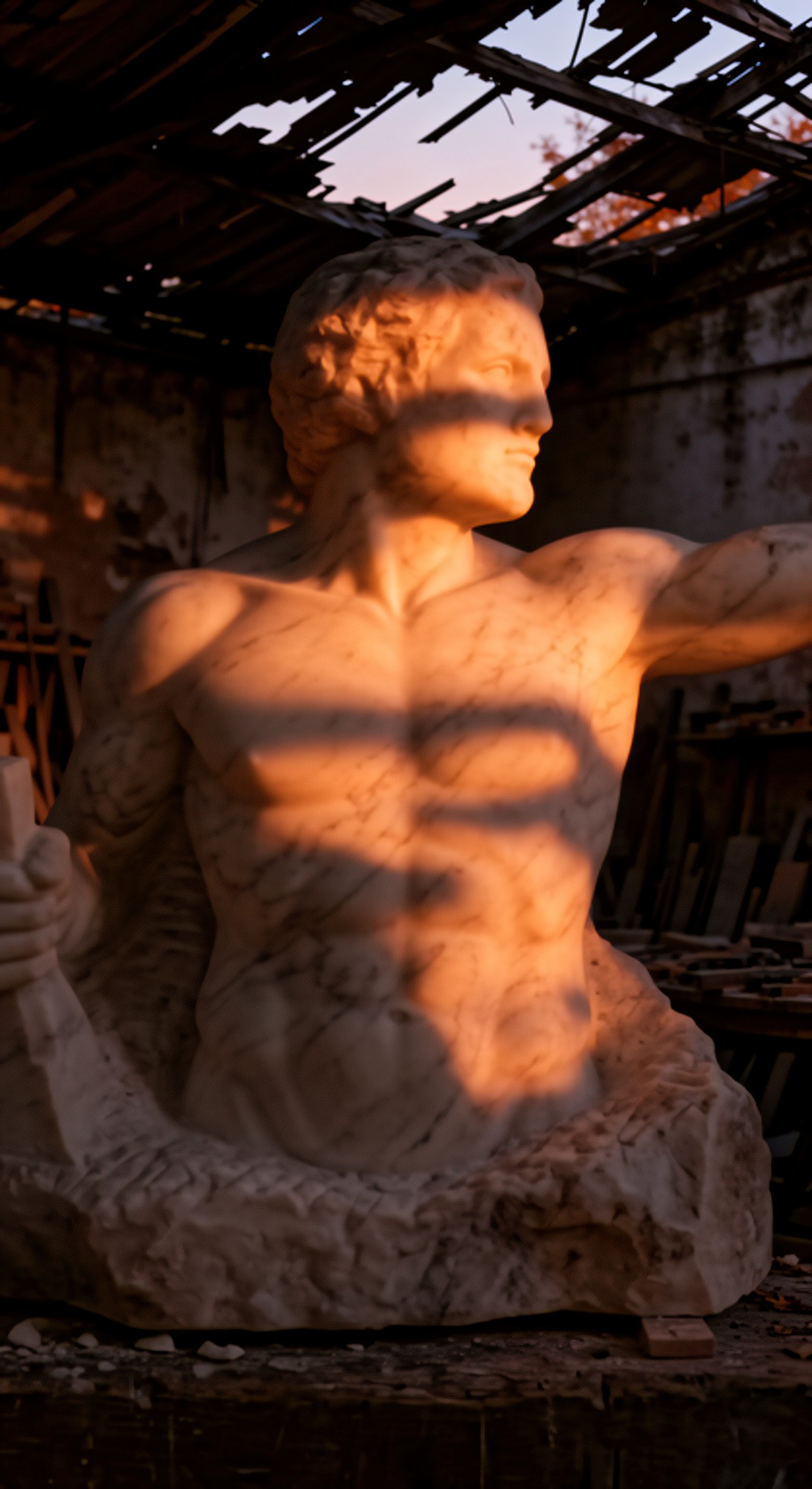
The roof had gone. Somerset weather takes a roof slowly — a slate at a time, one winter at a time — and then all at once. What was left was a cage of rafters open to the sky, and beneath it, sitting in the dirt and the fallen slate and the leaf litter of thirty autumns, this.
Pastel drawings, still pinned up, gone soft with damp. Offcuts of marble stacked against the wall the way a careful man stacks things he means to come back to. Chisels. Dust over everything, deep enough to hold a footprint. And the smell — this is the part I cannot get past — the smell of pastel and paint was still in that room. After all those years, with the roof open to the rain. Whatever he was, he was there long enough and often enough to put himself into the air.
The silence was deafening. That is a phrase people use loosely and I mean it exactly: there was so much absence in that room it had a volume.
He got as far as the face. Then he stopped, and the rest is still stone.
Look at what is finished and what is not.
The head is done. The jaw, the mouth, the strange calm of the eyes turned up and away toward something outside the frame — all resolved, all decided. The chest is nearly there. The shoulders carry that faint marbling of grey through the white that a sculptor either fights or surrenders to, and he surrendered to it, let it run across the ribs like an old bruise.
Below the waist, nothing. Still block. Still the rough quarried face of the stone as it came off the lorry, tool marks and all. He was working downward, the way you do, bringing a man out of a rock from the head first — and he never got past the hips.
I was told afterwards that he lived on that farm with his mother, that this was his craft, and that when she died he put the tools down and never carved again. I have no way to verify it and I have not tried. Some things you are told in a farmyard have the ring of a thing repeated for decades because it is simply what happened, and this had that ring.
What it means is that this figure is not unfinished the way a sketch is unfinished. It is unfinished the way a sentence is unfinished when the person speaking is interrupted by news. There was a day — an ordinary Tuesday, probably — when he was working on this chest, and there was an evening when he wasn’t, and he never was again. The chisel came off the stone in the middle of something. It has been in the middle of something ever since.
I photograph places where work stopped and no one came back — a lathe still set to a cut nobody finished, benches worn to the shape of hands that are gone. But those are machines, and machines outlive their operators without much complaint. This is different. This is a man who was in the process of making another man, and grief walked in and took the chisel out of his hand.
I waited for the light. It came late, low and orange through the broken rafters, and it did something I could not have arranged: it laid the shadow of a fallen beam straight across his chest, a dark band over the heart, and lit his face while leaving the unfinished stone below him in shade. The building drew the line between what he completed and what he abandoned. I only stood there and let it happen. That instinct — waiting rather than arranging — is most of what I actually do.
This piece does not settle quietly into a room. It asks something. Hung where you pass it daily, it will stop you at odd hours — usually late, usually when you are thinking about something else entirely — and you will find yourself looking at where the carving ends and wondering what you have put down and told yourself you will pick up again. It is not a comfortable work. It was not a comfortable afternoon.
He sits within Bone and Marble, among the effigies and the sleeping stone figures — except that all of those were finished, paid for, placed, and mourned over properly. He is the only one in that collection who never got to be anything.
I stood there a long time before I left. At gravestones I say the name aloud, because it is often the only time in years that name is spoken, and it costs me nothing to give it. I wanted to do that here. But nobody told me his name, and I did not think to ask until I was already three fields away with the light gone.
So there is a man in a Somerset shed with his mother’s death still holding his hands, and I cannot say who he was. Only that he could carve a face like that, and that he loved her enough to stop.
The Unfinished Son
Reference BM-320
Single edition — one print only
36 × 24 inches, Hahnemühle Photo Rag 308gsm
£950, with certificate of authenticity