On lanterns, last messages, and the long silence that follows
There is a moment, long after a thing has ceased to function, when it becomes something else entirely. The mechanism is still there — the lenses, the wicks, the pivoting iron — but the urgency that once animated it has gone, and what remains is a kind of concentrated stillness. A held breath. That is the quality I was after when I made this photograph. Not nostalgia. Something older, and stranger. The feeling of standing in a room where the last signal was sent a very long time ago.
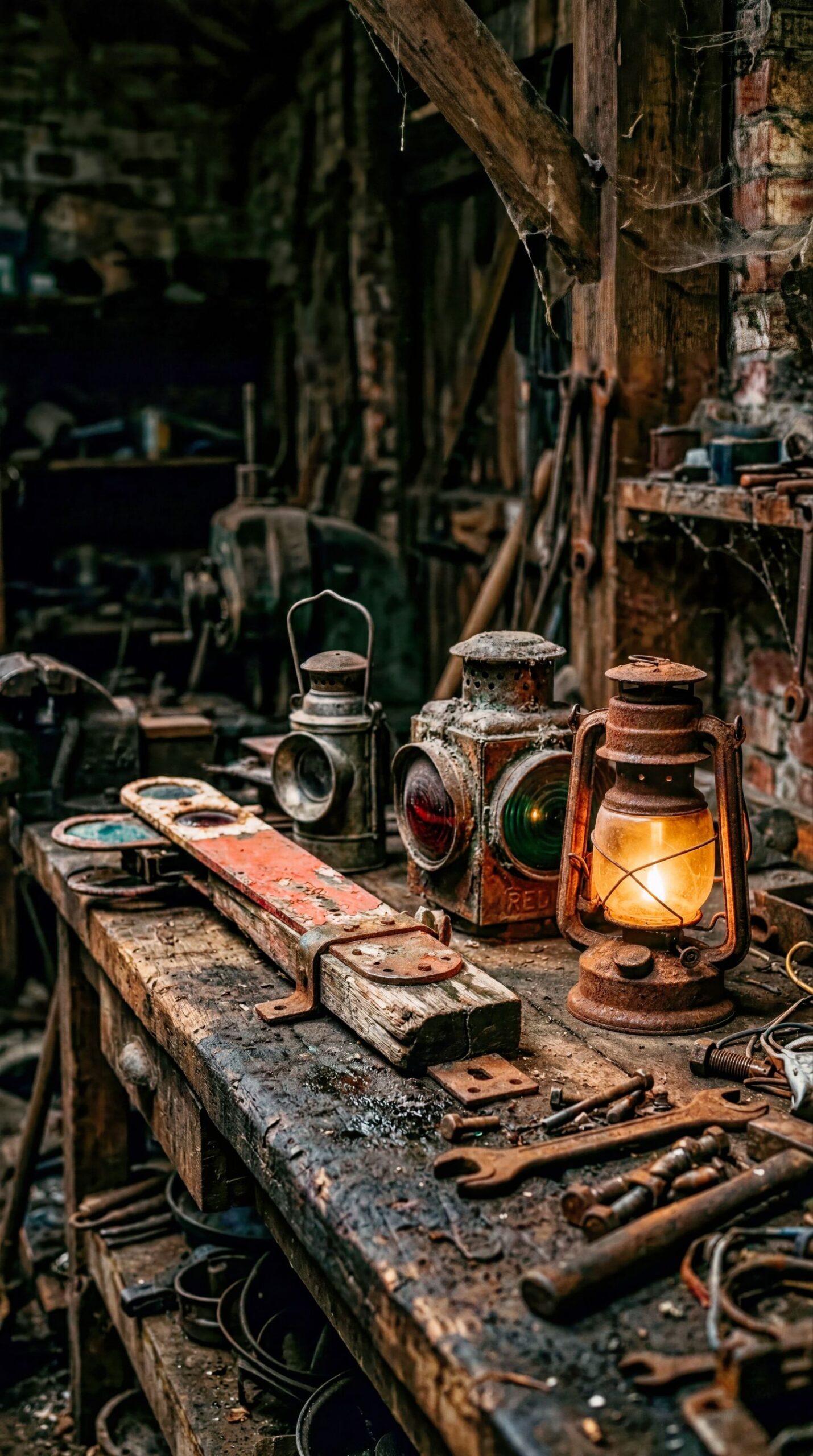
The lanterns on this bench were tools of precision and consequence. The large square lantern — its red and green lenses thick as bottle glass, ground to throw colour a quarter-mile down the track in fog and rain — was never decorative. It was an instruction. Stop. Proceed. The difference between a safe line and a catastrophe. Every time it was lifted and set into its housing, someone was trusting it with lives. That weight doesn’t leave an object simply because the object is no longer used.
The Urgency That Remains
What draws me back, again and again, to subjects like these is that residual urgency. The way certain objects seem to carry the tension of the moments they inhabited. I explored something similar in The Last Broadcast — a different body of work, different technology, but the same underlying condition: a communication device that once carried vital messages, now fallen into permanent silence. There is a particular melancholy to instruments of communication that can no longer communicate. They are frozen mid-sentence.
The smaller round signal lantern beside it on the bench reads, to my eye, like a companion — younger, perhaps, or assigned to a different part of the line. And then there is the oil lantern, and this is the detail I find myself returning to most. In a scene of cold iron and rust and the deep chill of industrial decay, this one lantern glows. Its amber light is almost indecent in its warmth. It shouldn’t belong here among all this disuse and oxidisation, yet it does — because warmth and cold have always coexisted in working life, and this bench is still, in its way, alive with the memory of work.
Reading the Bench
A good photograph, I have always believed, is one you can never quite finish looking at.
The workbench itself is a record. Bolts and wire and scattered metal debris speak to decades of maintenance, improvisation, repair. Someone worked here with their hands, with concentration, under pressure. The timber is worn smooth in places where tools were habitually set down; in other places the rust has eaten through to fibres that look almost textile in their softness. Across the whole surface, at a slight diagonal, lies the track gauge — that red-painted, weather-ravaged instrument for measuring rail separation, as critical in its time as any surveyor’s tool — and its placement feels less like abandonment than punctuation. A full stop at the end of a very long sentence.
I am often asked whether I plan these arrangements, and the answer is both yes and no. I look for a scene that already contains its own logic, its own internal grammar, and then I work to reveal it rather than impose one. What I found here was already composed — by decades of use, of carelessness, of someone having set something down and simply never returned to pick it up again. My contribution was the light, the angle, the patience to wait until the amber glow of that lantern found its relationship with the shadows behind it.
That relationship — warmth against cold iron — is, I think, the emotional core of this image. The lantern is not a symbol of hope, exactly. It is too matter-of-fact for that, too functional in its origins. But it is evidence that even in rooms built for industry, for signal and compliance, something warm was always present. Someone carried that lantern. Someone trimmed its wick and filled its reservoir and knew, precisely, the quality of its light.
Objects That Outlasted Their Purpose
This is the territory that The Relics Collection has always occupied — the space between function and obsolescence, where an object exists fully but serves nothing, and in that uselessness acquires a strange kind of authority. A relic, in the old sense, was a sacred remnant. Something preserved because of what it had been near, what it had witnessed, what had passed through it. These lanterns qualify. They witnessed the last years of a system of communication that is now entirely gone, replaced by electronics that leave no object behind.
Railway signalling, in its mechanical form, was tactile and human in ways that its digital successors are not. A signalman carried a lantern because his body had to be in the landscape, reading it, in relationship with the trains passing through it. The gesture of raising a lantern — green for clear, red for danger — was a language made of light and motion, spoken person to machine, machine to person. When that language became obsolete, what was left was not silence exactly, but the memory of sound: the creak of iron, the hiss of a wick, the distant percussion of a train taking the signal and running on.
A New Detail, Every Time
I made this image some time ago now, and I still find things in it. A reflection in one of the lenses. A quality of rust that, under examination, has the texture of velvet. The way the wire coils on the bench echo, almost accidentally, the curves of the lantern housing above them. If I look long enough, I find a small world — not the world of railway operations, which is documented elsewhere and by other hands, but the world of material time. The slow chemistry of iron meeting air. The darkening of wood under years of oil and grime. The way a thing acquires depth as it accumulates history.
This is, ultimately, why I photograph what I photograph. Not to preserve it — preservation is for museums and archives, and they do it better than I ever could. I photograph these things because they ask to be looked at slowly, and we live in an age that has almost entirely lost the habit of slow looking. To spend an hour with a signal lantern on a rusted bench, finding its angles, its light, its relationship to everything around it — that is, for me, a form of conversation. The object speaks. I try to listen carefully enough to pass something of what it says along.
The lanterns here sent their last signals long before I arrived. But they have not finished speaking.
The Signal Room is available as a limited edition framed cotton rag print, numbered 1 of 5. This is a work made for considered spaces — rooms where long looking is possible.
View the print and edition details →
For work exploring similar themes of heritage craft and industrial warmth, see Lantern & Iron. For the broader context of objects caught between function and memory, The Relics Collection is the place to begin.
30th July, 2026
The Room That Kept Its Lamps Lit — Limited Edition Fine Art Photograph

31st July, 2026
The Shape of Absence: Coastal Memory and Decay — Limited Edition Fine Art Photograph

4th August, 2026
Where the Bell Once Hung — Limited Edition Fine Art Print
