The Room That Kept Its Lamps Lit
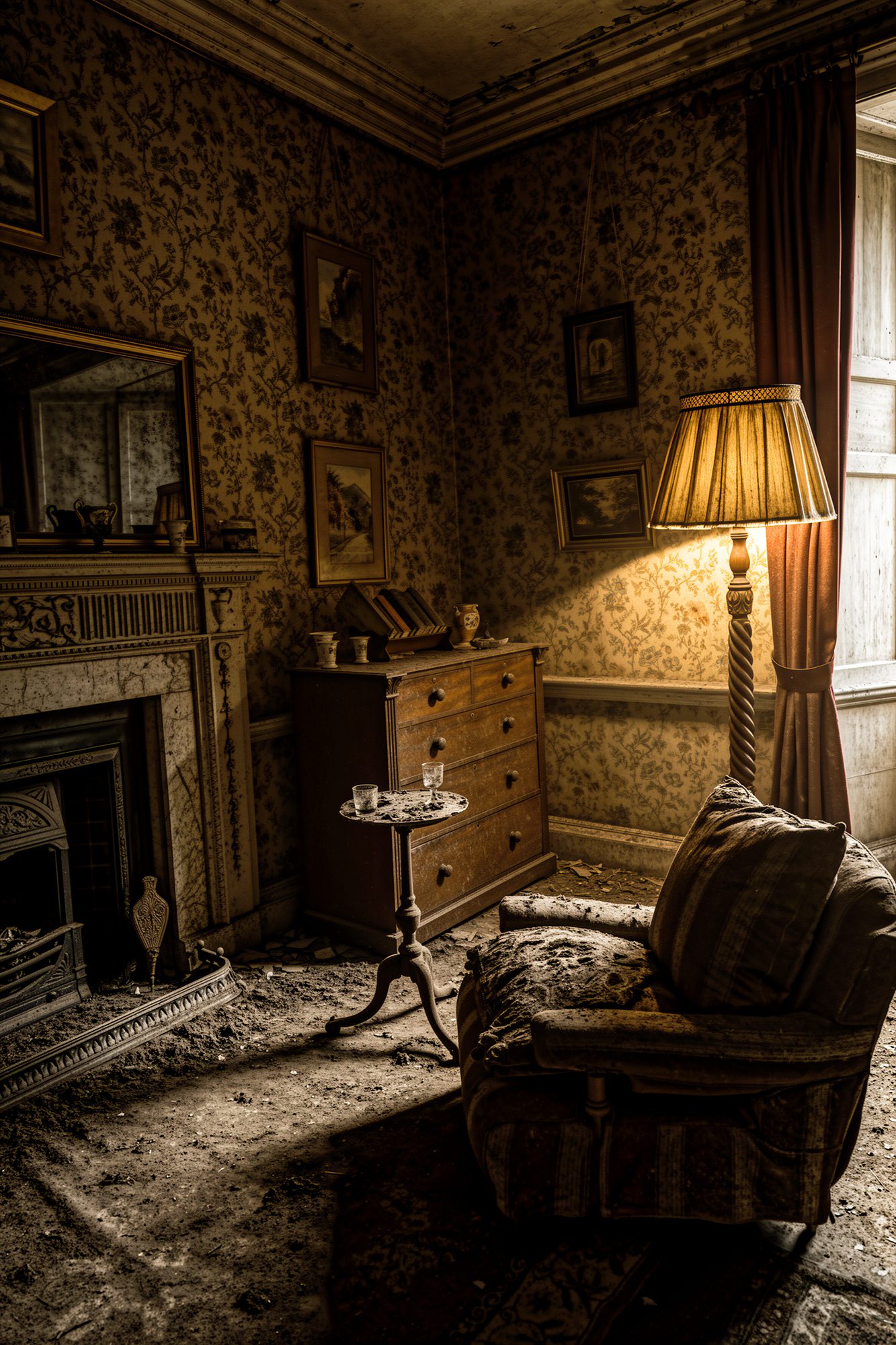
Somebody left in a hurry, or they left slowly over decades — the room doesn’t tell you which. What it does tell you is that when they went, they didn’t turn everything off. Two lamps still burn against the ruin of the wallpaper, warm and small and entirely at odds with everything around them.
The piano sits closed. Not covered, not protected — just closed, the way you’d close it before leaving for an evening rather than for good. Dust has settled across the lid in a fine grey film, and somewhere under that dust there’s a hairline crack in the veneer, the kind that comes from decades of a room breathing damp air in and letting it back out again, season after season, with nobody there to notice.
Above it, the paintings are still exactly where someone hung them. Gilt frames gone soft at the edges with rot and damp, portraits of people whose names are lost even to the house they’re still watching over. A dozen faces, looking out into a room that no longer has anyone to look back.
I had the light meter telling me to kill the lamps — cleaner exposure, better contrast, textbook chiaroscuro. I didn’t. Those two small bulbs were the only thing in that room that hadn’t given up, and I wasn’t going to be the one who finally switched them off.
That’s the decision this image is built on. Every rule I know about low-key interior work says darkness should be uninterrupted, that light should be rationed like it’s precious and controlled from a single source. And it is precious here — but not mine to control. Those lamps had survived longer than the roof, longer than the wallpaper, longer than whoever last sat at that piano. Leaving them burning felt less like a lighting choice and more like a small act of respect.
This work sits alongside the wider body of interior studies in Rooms After Conversation, where I keep returning to spaces that were clearly full of life once and are now full of something quieter — not emptiness exactly, more the shape a life leaves behind after it’s gone. I felt the same pull writing about the choir stalls in The Lamps of the Choir, where the light source became the whole emotional centre of the frame rather than a technical afterthought.
There’s a version of this photograph that’s more conventionally beautiful — moodier, darker, the lamps dimmed in post to let the paintings dominate. I didn’t make that version. The lamps stay bright because that’s the truth of what I found, and because somewhere in the editing I understood this wasn’t really a photograph of a room. It’s a photograph of two small refusals to go out.
I’ve written before about why I keep going back for images like this one, in What Draws Me There — it’s rarely the grandeur. It’s always the detail that shouldn’t still be working, and somehow still is.
I think about that piano lid more than the paintings, if I’m honest. Every portrait in that room is finished — hung, framed, complete, the way art usually is. The piano isn’t. It’s closed mid-thought, the way you close an instrument you intend to open again. Nobody did. That unfinished quality is what stayed with me long after the paintings had blurred together in memory, the way a held note stays in a room after the sound has technically stopped.
The Room That Kept Its Lamps Lit
Gallery-framed · Premium cotton rag · Shipped worldwide · Certificate of authenticity