The Fallen One
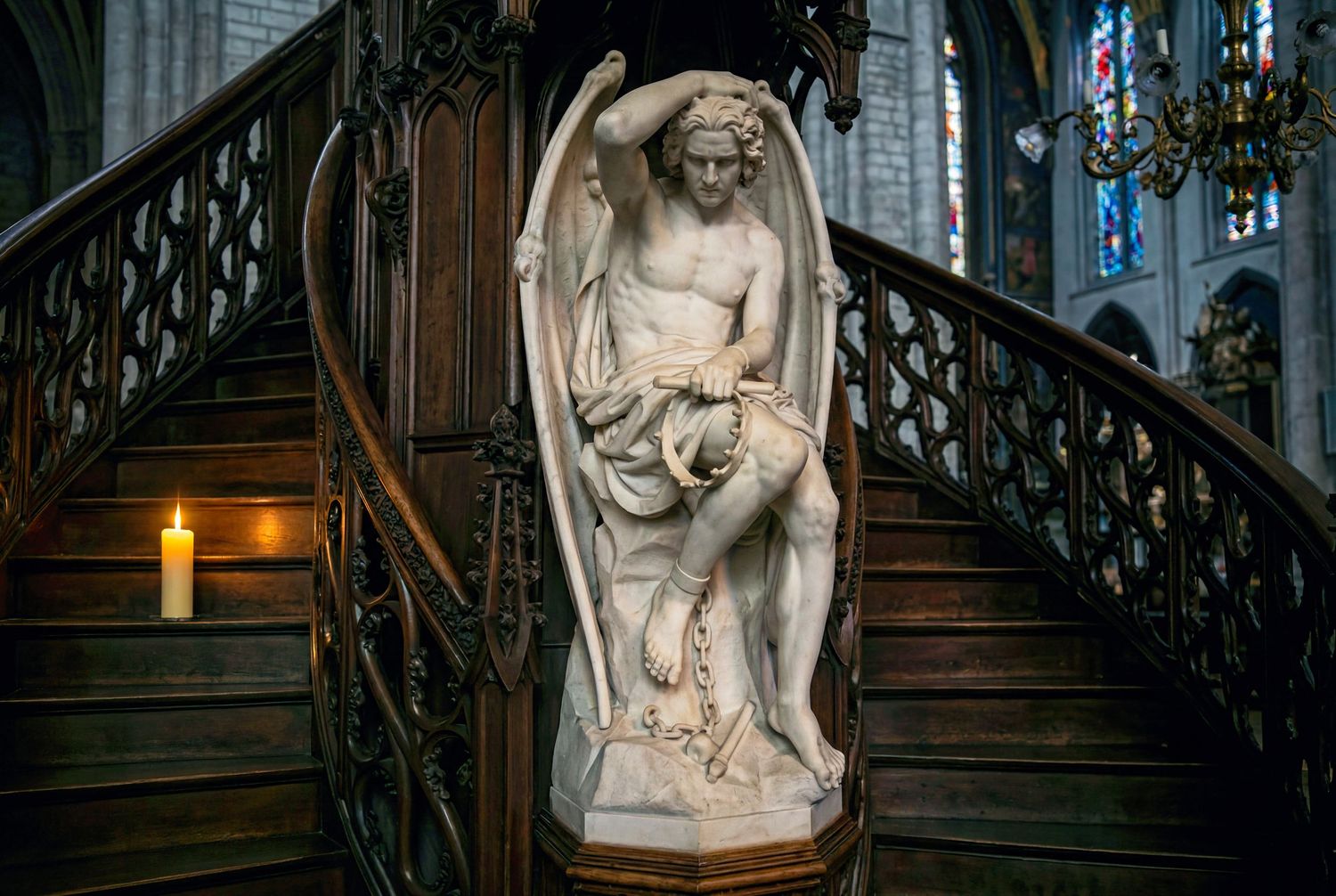
He does not look broken. That is the first thing you notice.
The chains are at his feet — not binding him now, but recently shed, or perhaps recently placed. His arm is raised. Not in supplication. Not in surrender. In something older than both. The expression on that marble face is one I have turned over ever since I stood in front of him in the half-dark of that Belgian Gothic interior — not rage, not grief, but the particular composure of a being who has already decided what this moment means.
The air inside was cold in the way old stone is always cold, even in summer. The kind of cold that sits in the walls and doesn't move. I could smell the beeswax from the single candle burning on the step to my left — that specific, thick, churchy smell that takes you somewhere before you've even processed it. I was alone with him. The tourists had gone. The wooden pulpit staircase curved above and behind, dark as walnut, carved to an intricacy I didn't have time to study because I couldn't take my eyes off the figure at its base.
A fallen angel seated not in shame but in stillness — as though he arrived here long before the church was built around him, and intends to remain long after.
This is the Lucifer of Saint-Paul's in Liège — Guillaume Geefs' marble, completed in 1848. But standing there with a camera and no plan beyond responding to what was in front of me, none of that history was the point. What I was looking at was a piece of stone that had been made to feel like thought. Like weight. Like the specific quality of someone who has lost everything and is choosing, very carefully, what to do next.
The stained glass behind and to the right cast almost nothing into this corner. What light there was came from that single candle — warm, low, moving almost imperceptibly. It caught the curve of his shoulder. The hollow of his collar bone. The chain draped across the plinth. Everything else receded into the dark of the wood, and that is exactly how I wanted it. If you explore the Bone and Marble collection, you will find that the most powerful images in it are not the ones where you see everything. They are the ones where the darkness holds something back, and you spend time wondering what.
There is nothing decorative about this image. It does not flatter its subject. It watches him. There is a difference, and it matters — I wrote about it in the blog on The Vigil of Stone, the way that marble figures in sacred spaces resist being photographed beautifully. They ask something heavier of the camera. They ask it to be patient.
This work lives quietly. On a wall it changes with the hour — in morning light it is cold and severe; in lamplight it becomes something more ambiguous, something that asks to be looked at again. The candle in the image seems to shift. The chain at his feet seems to carry weight. It is not simply observed. It rewards the kind of returning attention we rarely give anything anymore — and that, perhaps, is its own kind of defiance.
The composition belongs to a longer conversation about what candlelight does inside religious space — how it both reveals and withholds, how it makes the inanimate seem to breathe. That conversation runs through the Candlelit Guardian blog if you want to follow it further.
Five editions. Gallery framed. Printed on premium cotton rag — a surface that holds shadow the way stone holds cold: completely, and without apology.
The Fallen One
Gallery framed · Premium cotton rag print
Certificate of authenticity included