Iron Without Witness — The Collection
The Dead Engine
On flywheel, lantern, and the weight of a machine that stopped.
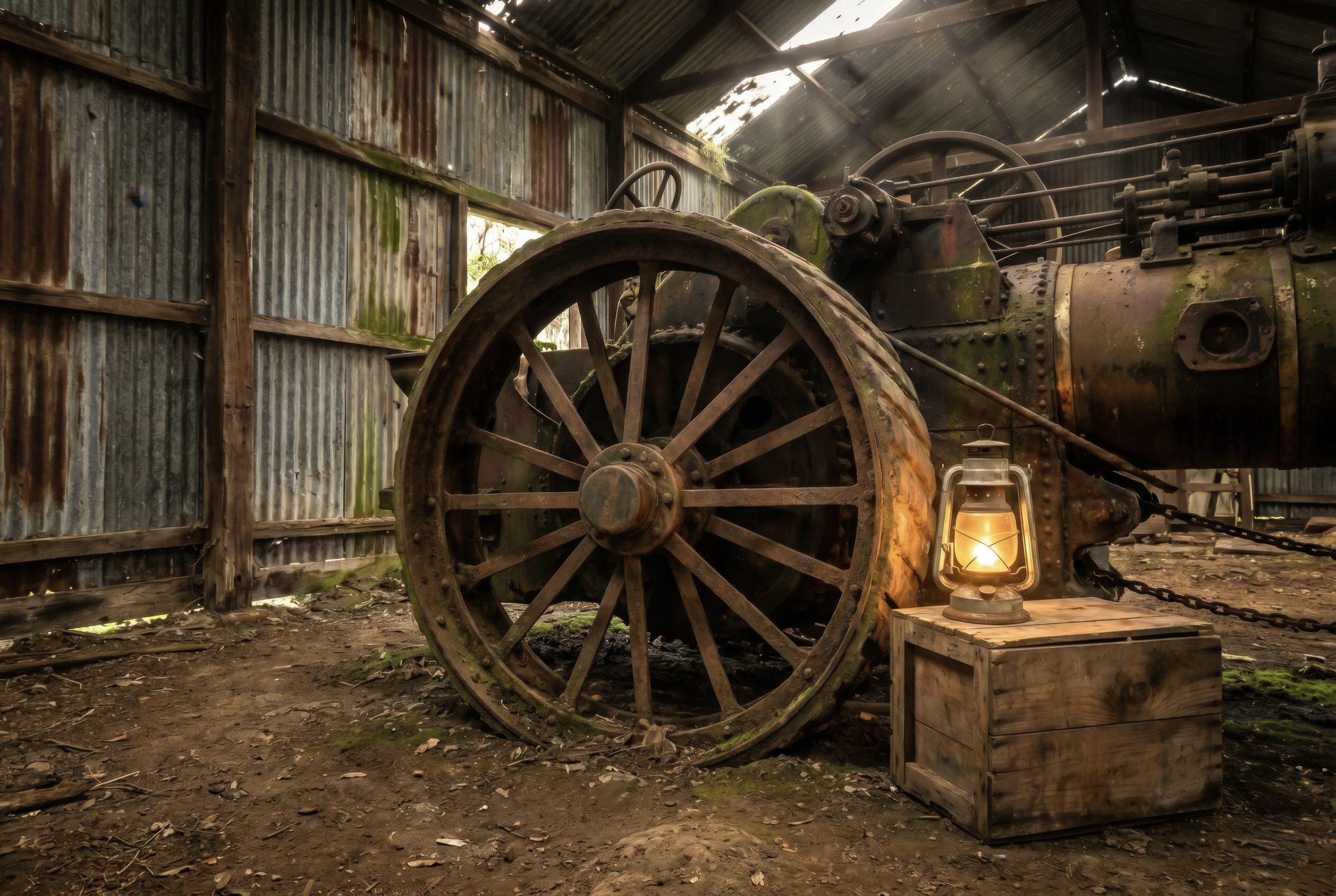
The flywheel is the first thing you see. It fills the left side of the frame — a wooden-spoked wheel taller than a standing figure, its iron rim eaten through with rust so deep it has become colour, become texture, become something closer to topography than corrosion. Behind it the riveted drum of the boiler rises in the half-dark, and up its flanks the moss has moved with the slow authority of everything that endures. Chains hang without purpose. Bolts and fittings protrude from casings that no hand has touched in decades. The corrugated iron walls of the shed lean inward at the top, light splitting through the gaps in long, dusty shafts that fall across the iron and vanish into the dirt floor below.
And then — on a wooden crate beside the engine — a kerosene lantern. Burning. Its amber glow the only warmth in a frame that is otherwise nothing but cold iron and the slow advance of green.
I placed that lantern there. Everything else had already been arranged by time.
What the Flywheel Was For
A flywheel’s purpose is to resist change. It stores rotational energy — smoothing the power strokes of an engine, keeping momentum when the mechanism briefly falters, carrying the system through its dead points. The larger and heavier the wheel, the more it resists interruption. Every detail of its construction — the mass of the rim, the spokes radiating outward, the precise engineering of the iron hub — exists to maintain continuity of motion. To keep going. To refuse to stop.
That is the deep irony of what this wheel has become. The thing built to resist stopping has now stopped so completely that nature has had time to establish itself in the gap between where the wheel sits and where the light falls. Moss requires months. Sometimes years. The flywheel resisted change for as long as it could, and then, when something finally gave — a drive shaft, an owner’s ambition, a season that turned and never recovered — it stopped with the same totality it had once given to motion. It stopped the way only a heavy thing can stop. Absolutely.
This image belongs to Iron Without Witness, a body of work built around machinery and ironwork that has outlasted the attention of the people who made it. The flywheel is the emblem of the whole project — an object designed to express human will over physical entropy, now taken back by the very forces it was built to oppose. What I find in these spaces is not defeat, exactly. It is completion. A thing cannot reach this state without first having been used. Without having mattered. The rust and the moss are not the story of failure. They are the evidence of a full life.
The Lantern as the Only Witness
When I carry a lantern into a space like this one, it is not for sentiment. It is because a space that has no warm light source reads, photographically, as simply dark. The shed has shafts coming through the roof — beautiful shafts, the kind that take their time crossing the frame — but they are cold. They describe the dust and the iron without illuminating it. The lantern does something different. It chooses a point in the darkness and insists on it.
In this frame, the lantern sits on its crate at roughly the same height as the flywheel’s axle. The amber light catches the lower spokes, pools along the base of the boiler drum, and throws the near side of the corrugated wall into a warmth that the rest of the image refuses. The contrast is not decorative. It is structural. It creates the photograph’s central argument: that something still burns here. That attention, directed into a space where attention has been absent for years, changes what that space means. If you want to understand the philosophy behind that choice more fully, I’ve written about it directly in how atmosphere is created — the difference between light that reveals and light that interprets.
The lantern is not nostalgia. It is the last argument against forgetting — the one warm thing left in a room that has given everything else to cold and moss and time.
There is also the matter of what the lantern implies. A burning lamp requires someone to have lit it. In a space that has been abandoned — where the machinery stopped one day and was never touched again — a burning lamp is a paradox. Something is present here that the rest of the image denies. I think of it as the photograph’s conscience. The image knows it is looking at an ending. The lantern is what keeps that ending from becoming merely elegiac. It keeps the question open. It is the thing I find most worth looking at in the frame, though I placed it there myself. That is the strange reciprocity of this kind of work. You introduce an element, step back, and find that it has taken on a meaning you did not entirely intend.
The heritage tools and light-sources I work with across this body of work have their own context in the lantern and iron collection — if the relationship between flame and ironwork interests you as a visual subject, there is more there.
Why Endings Hold the Attention
There is a well-established psychological fact that images of conclusion are more absorbing than images of beginning. We look longer at the last frame than the first. Abandoned spaces, decommissioned machinery, structures in the long process of returning to the earth — these hold us in ways that their operational counterparts do not. I have thought about why this is for most of my working life, and I think it comes down to this: the ended thing is finished being complicated. It has arrived somewhere. It asks you to look at what it became, not to anticipate what it might do next.
The flywheel in this image will not turn again. That knowledge changes how you stand in front of it. You are free to simply look — at the depth of the rust, at the light through the spokes, at the moss that has had the patience you and I have never been able to sustain. You are not watching for what happens next. You are in the presence of what was.
This is not melancholy for its own sake. I am not interested in ruin as aesthetic. What I am interested in — and what I think the best collectors of this work respond to — is the weight of completed time. The flywheel took enormous human effort to build, enormous mechanical effort to run, and enormous courage to walk away from when the walking away finally came. All of that is present in the iron. You can feel it without knowing the history. The body understands it before the mind does. I’ve explored this idea in full in stillness is not passive — the essay that has, more than any other, shaped how I understand what I am doing when I make work like this.
The objects-and-memory aspect of this image — the way a machine accrues significance through use and abandonment — is also central to the relics collection, where the same question about material culture and the things that outlast purpose runs through every frame.
On Collecting Work That Thinks
I want to be direct with you, because I think you deserve directness. There is a difference between a photograph that decorates and a photograph that thinks, and it is not a subtle difference. A decorating photograph fills space. It is pleasant, it coordinates, it does its job and asks nothing in return. A thinking photograph changes the room it is in. Not because it is difficult — complexity for its own sake is just another kind of emptiness — but because it contains a genuine point of view. Because someone stood somewhere specific and made a decision about what light meant and what stillness meant and what it is worth our time to look at carefully.
This image is one of five. Five prints total, produced on cotton rag, framed, each one going to a home where someone chose it deliberately. That specificity matters to me. Not as a commercial strategy but as a curatorial commitment. I do not want this image on a hundred walls. I want it on five walls where it will be looked at — really looked at — for the next thirty years. Where morning light will catch it differently than evening light. Where someone will stand in front of it before coffee and see one thing, and after dinner see another, and find that it sustains that kind of repeated attention without surrendering. That is the test I apply to any image before I release it: will it still be worth looking at in three decades? The dead engine passes that test. I believe it passes it emphatically.
The kind of collector who is drawn to this work is someone who has been collecting long enough to know the difference between what they bought because it was impressive and what they bought because it was true. Those are not always the same objects. The impressive thing announces itself and then quiets. The true thing is still speaking ten years later, from a different part of the room than the one you originally hung it in, in a voice that has changed register slightly because you have changed. That is what I am offering with this image. Not a statement piece. A long conversation.
If you are at that stage of collecting — if you are looking for work with that quality of duration — I’d encourage you to spend time in the collectors vault, where the serious work is held and presented with the context it deserves. And if you want the breadth of what I make before deciding, the atlas is the full archive.
The Dead Engine — Limited Edition Print
Cotton rag, framed. Part of Iron Without Witness. Five prints in the edition. Each print is accompanied by documentation of the location and a signed certificate of edition. If you are considering acquiring this work, the print store holds the full specification and enquiry details.
Edition of 5 · Cotton Rag · Framed · Signed & Certified