The Vase No One Emptied
The house made no sound. Not the settling of timber, not water in a pipe, not a bird against the glass. Nothing. I stood in the doorway of that kitchen long enough to hear my own pulse, which is what silence does when it has been left alone for years — it hands you back your own body.
Empty houses are full. That is the thing people misunderstand about them. They are crowded with memory, but the memory is invisible. It is in the air, in the worn place on the floor where somebody stood at a sink for thirty years, in the particular height of a shelf that tells you how tall a woman was. You cannot touch any of it. You walk through it the way you walk through cold.
And then, on the table, there was this.
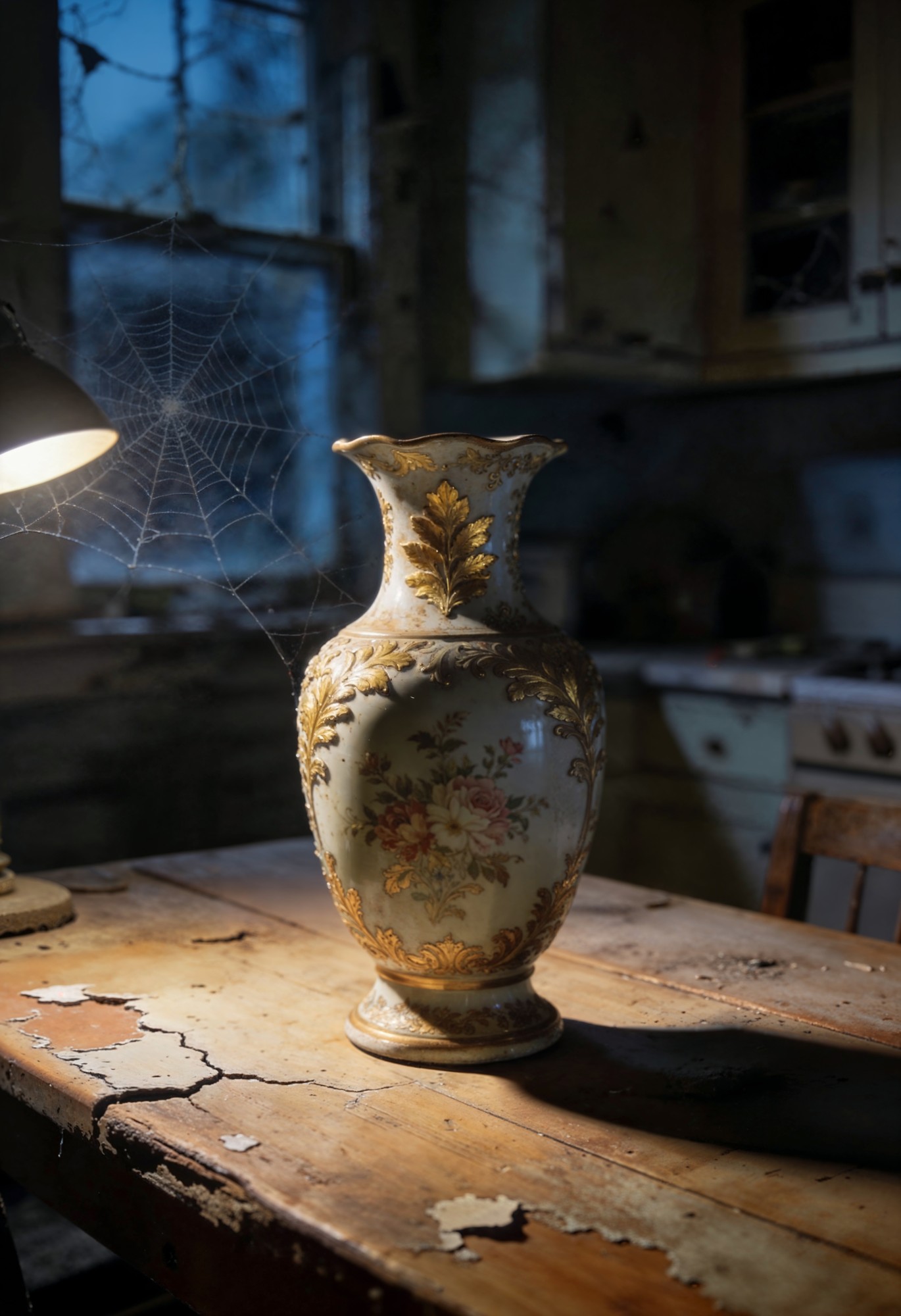
A vase. Gilded acanthus curling up the shoulder, a panel of roses painted by hand, a fluted lip finished in gold. Someone had chosen it. Someone had paid more than they should have for it, carried it home, set it down, filled it. Someone had stood exactly where I was standing with cut flowers in their hand and water still dripping from the stems. Of all the memories in that house, this was the only one I could have reached out and lifted.
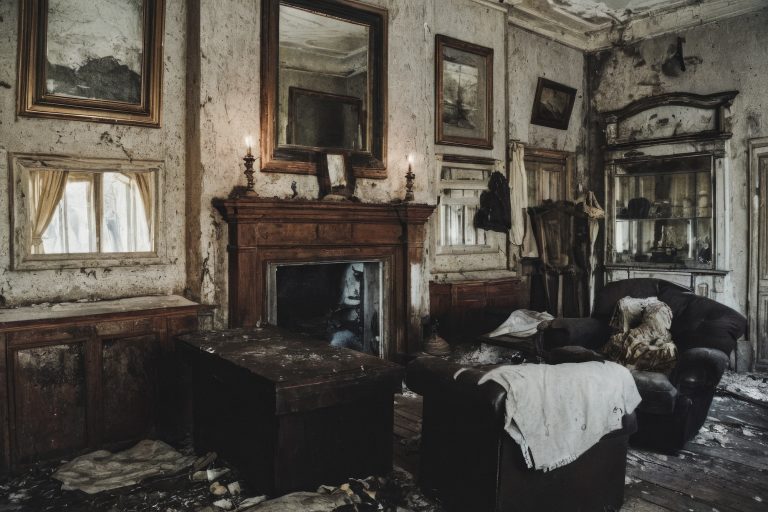
Everything around it had already surrendered. The tabletop was cracked and lifting, its varnish flaking into pale islands. A spider had spent a season stringing its web across the window and then abandoned that too. Beyond, the cupboards stood open on nothing, the range gone cold past the memory of heat. Decay had worked its way through the room with the same patience it brings to the interiors in Forgotten Kitchen — thorough, unhurried, entirely without malice.
The vase had not surrendered. It sat there, upright, gold catching nothing because there was nothing for it to catch.
Everything else in that house was memory. This was the only thing memory could be held against.
There was no light in that kitchen worth the name. Only the dead blue of dusk pressing at the window, flat and cold and utterly without mercy. So I opened the camera bag and took out a lamp, and I set it where the morning light would once have fallen, and I turned it on.
I have thought about that decision since. It was not a technical one. A colder frame would have been the honest record, and the record was not what I was there for. What I wanted was for someone, once, to see that vase the way it was seen when it was loved — warm on one side, in a room where the kettle was on. I did not light it to reveal it. I lit it to give it back something.
That is the whole photograph. Hope introduced by hand into a place that had run out of it. The gold answers the lamp. The roses come up out of the dark exactly as far as the light permits and no further, and the rest of the house stays where it belongs, behind, in blue, in the cold. Houses like this hold their breath for decades. This one, for a few minutes, exhaled.
On a wall, this piece does not announce itself. It waits. It settles into a room the way an old object does — unnoticed at first, then, at some hour of the afternoon when the light moves across it, suddenly the only thing in the room you are looking at. The gilding warms. The web sharpens. Someone will ask you what happened in that house, and you will find that you have no answer, and that you do not want one. It is not a photograph you finish. It is a photograph you keep returning to, for reasons that never quite resolve — which is, in the end, why I go into these places at all.
I have a habit in old graveyards. When a name on a headstone has weathered down to almost nothing, I read it aloud, once, so that it has been said in this century by somebody. It costs nothing. It changes nothing. I do it anyway.
That vase had no name for me to say. Nobody had emptied it, nobody had taken it, nobody had come back for it, and there was no word I could put into that silence that the silence would have accepted. So I gave it the only thing I had in the bag. I gave it a light, for about four minutes, and then I packed up and I closed the door behind me and I left it standing exactly where they had left it — in the dark, holding nothing, still beautiful, still waiting for water.
The Vase No One Emptied
Gallery-framed · Printed on premium cotton rag
Issued with a certificate of authenticity
This work belongs to The Forgotten Room — interiors left mid-sentence, and the objects that stayed behind to finish them.