The Hands Do Not Unfold
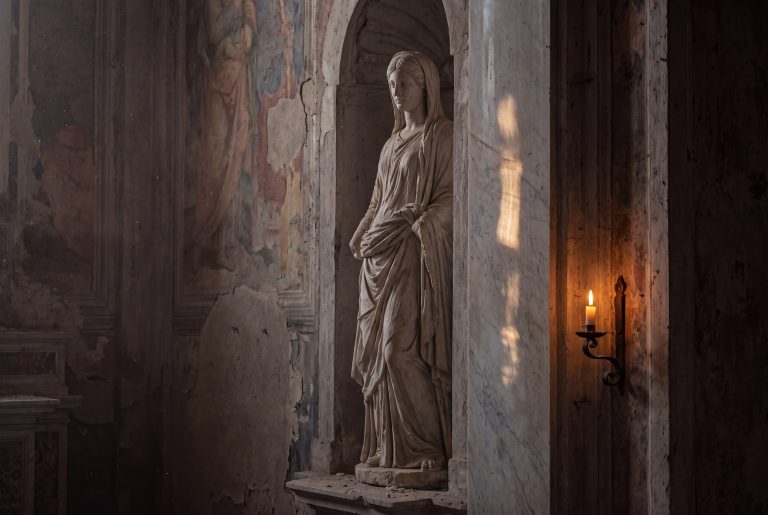
The cold inside a chapel is not the same cold as the field outside it. Outside, cold moves. It has weather in it, and wind, and the smell of wet grass. Inside, the cold simply sits. It has been sitting for centuries. It comes up out of the floor and settles against your shins first, then your spine, and it does not hurry, because it has nowhere else to be.
I stood in that cold for a long time before I looked at anything properly. There is a silence in these places that is not the absence of sound but the presence of something else — a held breath, an occupied stillness. Sound does not travel in it so much as get absorbed by it. Your own footsteps arrive back to you a half-second late and softer than you sent them.
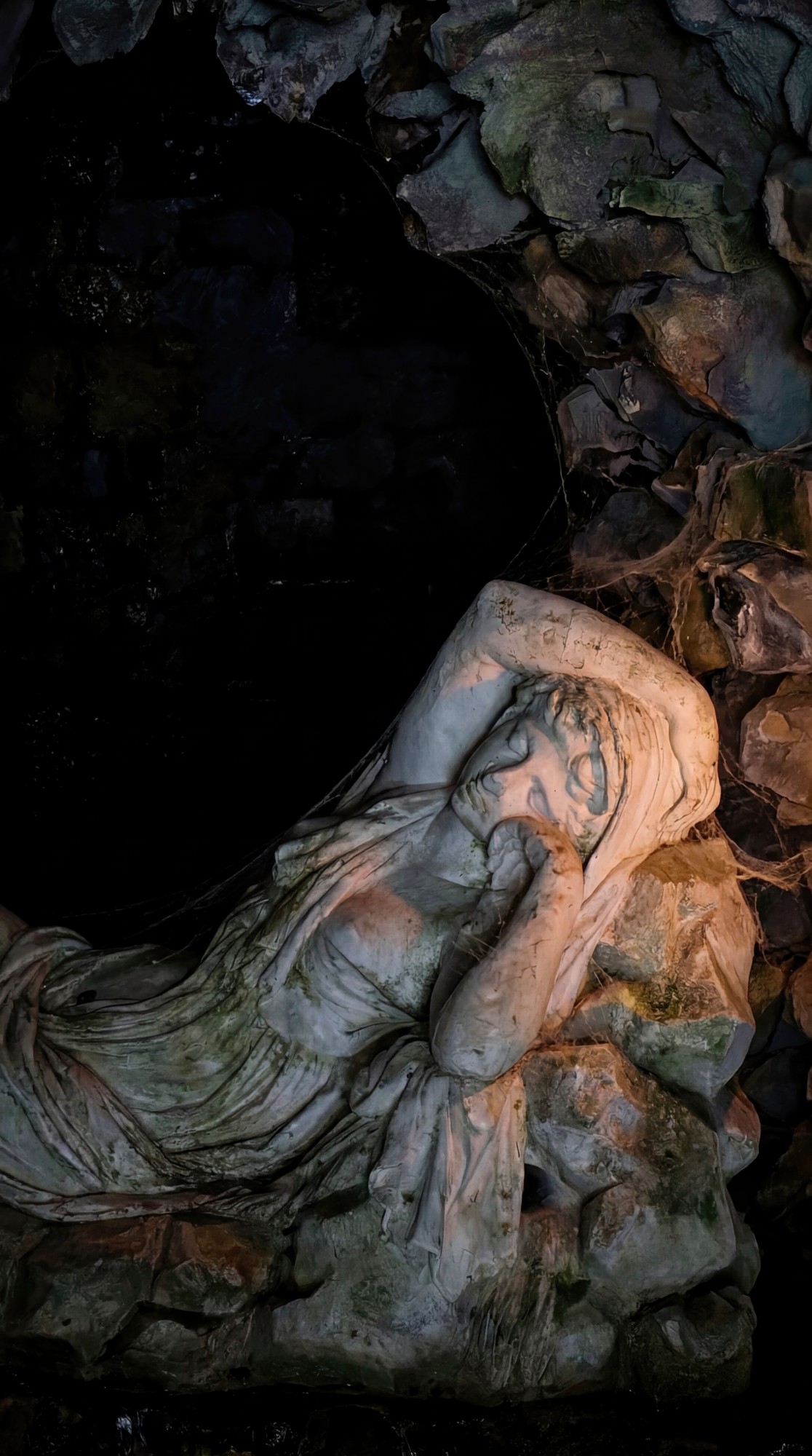
And there she lay. A memorial. Somebody’s wife, somebody’s daughter, somebody’s whole world, carved in marble and laid down on a plinth so that grief could have somewhere to put itself.
But it was the hands I could not leave.
One laid gently across the other. Not clasped in prayer. Not gripping. Simply set down, the way hands are set down when the work is over and there is nothing left to hold. The fingers slightly parted. The knuckles soft. Beneath the surface, the marble’s own grey veining runs across the back of the hand exactly where a vein would run beneath skin, and the light finds it, and for a moment the stone is not stone.
That is the craftsman’s doing. Someone spent months on those hands. Someone who had never met her, working from a description, from a drawing, from another mourner’s memory — and yet he understood. He understood that the face would be seen from a distance and the hands would be seen from here, close, by the ones who came alone and stayed too long. So he put everything into the hands. The nail beds. The tendon rising as the middle finger lifts a fraction. The way the smallest finger falls away from the others because a resting hand always lets one finger go.
I have sat in St Peter’s at Stourton until my body cooled to the temperature of the stone around me, and something in the arithmetic changes when that happens. You stop being a visitor. The difference between the effigy and the person standing over it becomes a matter of degrees and time, nothing more. That is the same understanding I feel in the paintings of Caravaggio, felt deep within the bones — light does not describe a form, it decides what part of a life we are permitted to witness. Here it decided on the hands, and it left the face in shadow, and it was right to. This is the same instinct that runs through everything in Bone and Marble — the belief that a body tells the truth in its extremities long before it tells the truth in its face.
Someone commissioned these hands because they could no longer hold the ones they were carved from.
Look at the index finger. The tip is gone. Broken away — a knock, a fall, a careless century — and what remains is a raw pale facet where the polished surface used to be. It has weathered to a dull cream while everything around it still holds its shine. Nobody repaired it. That absence has become part of the monument now, as much a part of it as the drapery folds beneath, and it belongs to whoever broke it and never came forward.
A photograph like this one does not announce itself on a wall. It waits. It changes with the light through a room — cold morning light will find the veining and the grey, and low evening light will lift the warmth out of the cream and make the marble look almost tired. It reveals itself over time. You will walk past it for a fortnight thinking of it as a photograph of a sculpture, and then one afternoon you will notice that the hands are not the hands of a saint or an allegory but of a person, and you will not walk past it in the same way again. This is close to what I have written about elsewhere in The Vigil of Stone, and it is bound up in what draws me to these places in the first place — the sense that something is being kept, and that I have arrived very late to the keeping of it.
I photographed it, and then I stayed. And at some point, standing there in the cold with nothing to do but look, I realised that my own right hand had come to rest across my left on the top of the camera. Fingers parted. Smallest finger fallen away. The exact posture of the stone, made without a thought, by a body that already knew how it goes. The carver knew it too. That is why he did not fold them in prayer. He knew that this is what hands actually do at the end — not beseech, not clutch, not perform. They simply stop, one across the other, and the light comes in from the side, and they do not unfold again.
The Hands Do Not Unfold
Gallery-framed · Premium cotton rag · Issued with a certificate of authenticity
Five people will live with this. The cold of that chapel is in it, and it does not fade.
There is a memorial I return to where the sculptor gave almost nothing to the face and everything to the hands — one laid across the other, the index finger broken away sometime in the last three hundred years and never repaired. I wrote about standing in front of it in life in the stone, because it taught me that stone does not imitate the body. It waits for the light to admit that they are the same thing.