The Difference Between Seeing and Looking
We see thousands of things every day and remember almost none of them. The car parked outside your house this morning. The colour of the ceiling in the room where you ate breakfast. The expression on the face of the person who handed you your coffee. All of it absorbed. None of it held. Seeing is something the eye does without asking permission from the mind.
Looking is different. Looking costs something. It requires you to stop — not just physically, but internally. To suspend the part of you that is already moving toward the next thing. Most people never do it, not because they aren't capable, but because nothing has ever asked them to. The world has learned to shout, and we have learned to skim. Attention has become a scarce resource, and almost everything around us is designed to steal it rather than earn it.
I have spent thirty years trying to make photographs that ask people to look. Not photographs that demand attention through spectacle or colour or the obvious drama of a moment. Photographs that draw you in slowly. That reveal themselves over time. That change, almost imperceptibly, the longer you stay with them. The kind of image that rewards the viewer who is still there five minutes later — because they found something the first glance didn't give them.
Seeing is what the eye does without asking permission from the mind. Looking is what happens when something stops you before you realise you've been stopped.
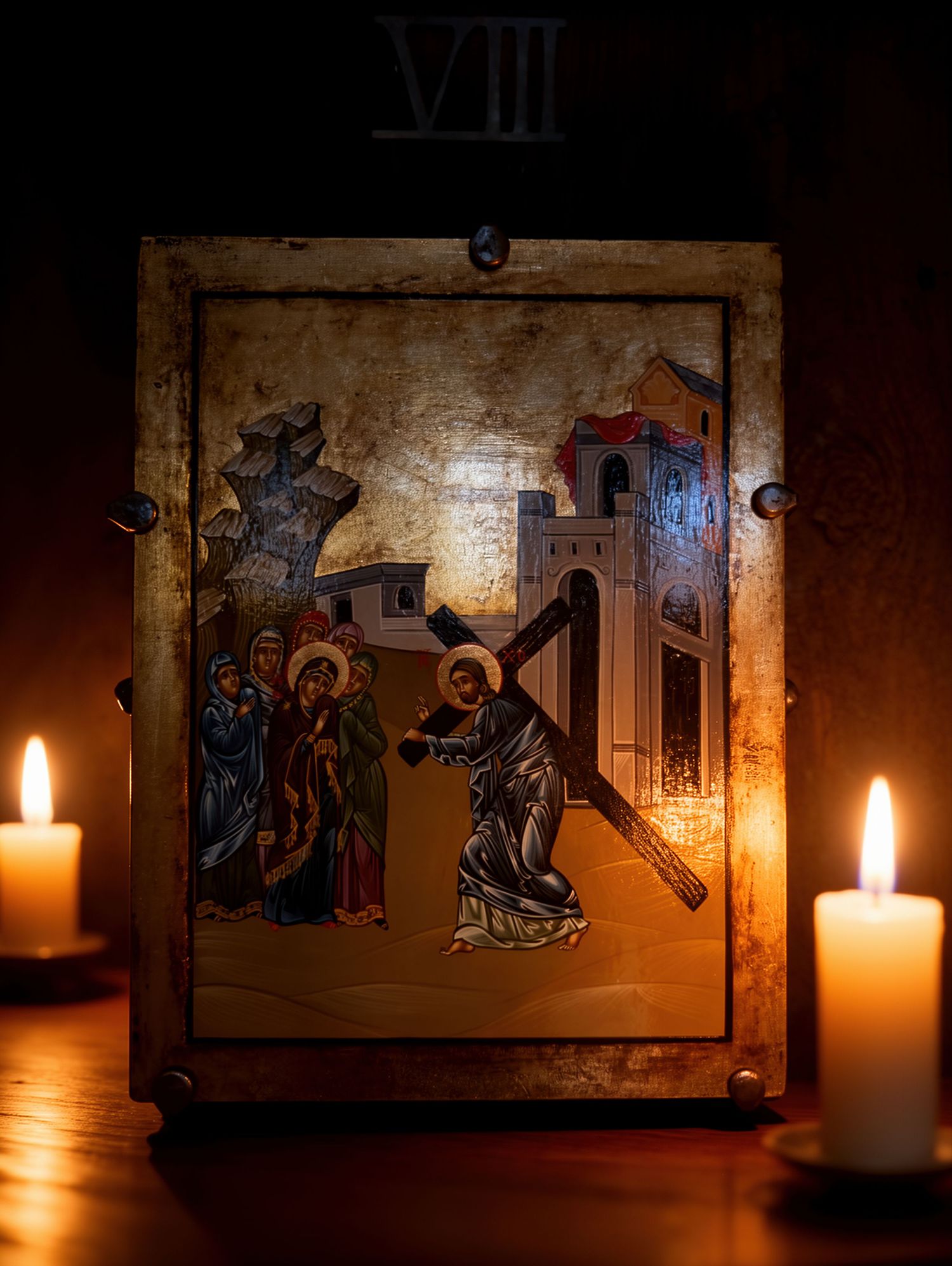
I was standing in a side aisle of a church — one of those churches that smells of stone and old candle wax and something underneath both of those, something older, something that has no name — when I noticed it. A small painted icon mounted low on the wall, flanked by two candles burning at different heights. Station VII of the cross. The figure bent beneath the weight of the timber, a group of women watching from the left, a city wall rising behind him into shadow. Gold leaf ground. The sort of image I'd walked past a hundred times in a hundred churches, barely registering it.
But the candlelight had done something to it that afternoon. It had taken a flat devotional object and given it atmosphere, given it breath. The flame to the right was throwing light across the gilded surface unevenly, so that parts of the scene were almost lost to darkness and other parts were vivid — the bend of the figure's back, the heaviness of the timber, the faces of the women turned toward him with expressions that weren't grief exactly. Something more complicated than grief. Something that knew what was coming and had made peace with not being able to stop it.
I stood there for a long time before I raised the camera. This is the moment I mean when I talk about the difference between seeing and looking. I had seen that icon. And then, at some point I can't precisely identify, I began to look at it. The shift is not dramatic. It doesn't announce itself. It happens the way your eyes adjust to a dark room — gradually, and then all at once, and then you can't remember what it was like before.
The photograph I made that afternoon — the Roman numeral VII hanging in the dark above, the icon warm and gold between its two flames — is not a record of what was there. It is a record of the moment looking replaced seeing. Of the few seconds when that small painted panel stopped being background and became the only thing in the room. That quality is something I write about more in what draws me there — the internal shift that happens before the camera comes up, and why I've come to trust it over almost everything else.
What separates a viewer from a collector, I've come to believe, is not taste or knowledge or even money. It is the capacity to look. Most people who encounter a photograph like this one will see it — they'll clock the candles, the icon, the darkness, the gold — and move on. A smaller number will stop. And a smaller number still will find themselves returning to it, not because they decided to, but because something in the image is still asking a question they haven't finished answering.
This is what I mean when I say my Candlelight Antiquity collection is not about sacred objects. It is about the quality of attention those objects can provoke. The icon in that image has been looked at by thousands of people across its lifetime. Most of them saw it. A few of them stopped. What the candlelight does — what low light does, in general — is slow the eye down. It removes the easy read. It forces the viewer to lean in rather than skim past. And in that slowing, something shifts. The image begins to give itself up, slowly, the way a room does when you've been sitting in it long enough for it to stop performing and simply be.
Thirty years of this work has taught me one thing clearly: the photographs worth making are the ones that cannot be seen quickly. The ones that require you to bring something of yourself — patience, stillness, a willingness to be uncertain. Because looking, real looking, is not a passive act. It is a form of presence. It is what happens when you decide, even briefly, that this thing in front of you is worth more than the next thing you were already reaching for. This piece rewards that kind of attention. It changes with the light in the room where it hangs. It settles into a space over time, giving back something different depending on the hour, the season, the mood you carry in with you.
There is nothing loud here. There was nothing loud in that church aisle either, that afternoon, with the candles burning and the gold catching what little light there was. Just the particular quiet that gathers in a place where people have stood for centuries and looked — really looked — at something they couldn't quite explain but couldn't quite leave. I wrote more about that quality of space in when a place chooses you. It is not a choice I make with the rational part of my mind. It is something older than that.
See less. Look more. The rest follows on its own.