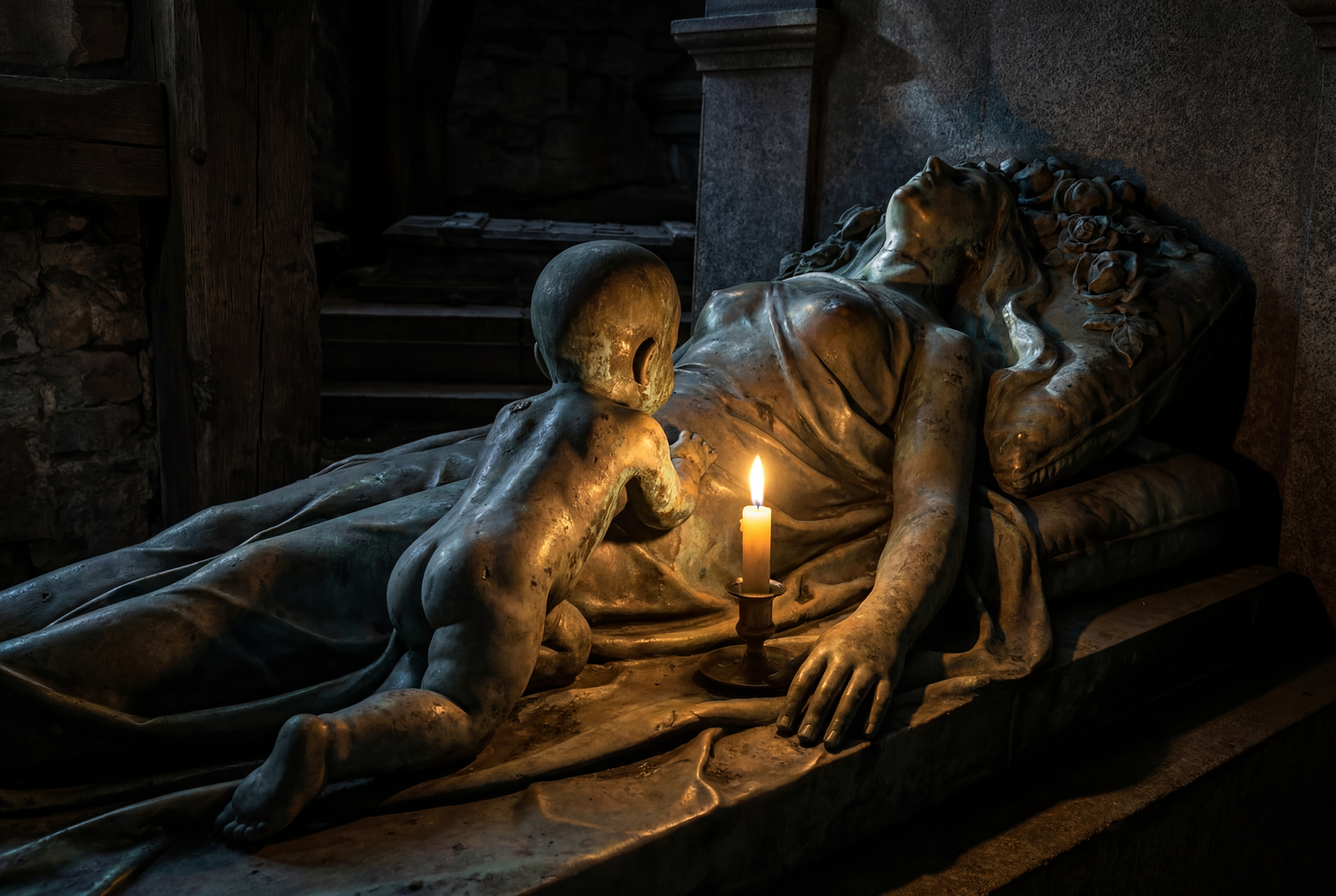
The Company of Those Who Sleep
There is a particular quality of silence that belongs only to graveyards. I have known it since childhood — that stillness which is not emptiness, but rather a fullness held very quietly. A child notices these things. The names carved into stone. The dates that span a life in three digits and a dash. The flowers left and then forgotten. The ornate and the plain, the elaborate and the stark — all of them equalised by the same long grass, the same patient sky.
I was fascinated early by what graveyards hold without making any fuss about it. History is a textbook abstraction; a grave is a fact. A person stood here. Was known here. Was loved here. And then was not. The stone remains because someone decided the remembering mattered — that there should be a mark, however weathered, however slowly the letters soften back into the surface from which they were cut.
Photography became, for me, the only tool I had to hold these things without disturbing them. Thirty years and many countries later, that impulse has not changed. I still arrive at a graveyard the way I always have — slowly, on foot, with no particular destination — and I let the light find what it will. I have worked in church interiors where the dead are folded into the architecture itself, their effigies pressed into the floor or elevated into alcoves, hands clasped, eyes closed, the posture of a sleep that has lasted five centuries.
But it is the outdoor monuments that find me most often. The ones exposed to weather. The ones that have earned their patina.
"I paced the churchyard in the sun, / While all the graves were green and fair... / And peace was in the quiet air."
— William Wordsworth, The Churchyard among the Mountains
Wordsworth understood what I have always felt but rarely been able to articulate so cleanly: that walking among graves is not morbid. It is the opposite. There is a particular peace in the company of the dead — something in the fact that nothing is required of you there, that the urgency which drives most hours simply does not operate inside those walls. The pace changes. The breath slows. The eye lingers.
This image was made in Spain. The sculpture it holds is by the Catalan sculptor Josep Dalmau (1867–1937), and what he carved from marble is among the most devastating things I have ever stood before. The work is known as Mother Dead in Childbirth — a woman recumbent, the posture of sleep or surrender, her features not arranged for grief but for something quieter than that. Marble so precisely worked that it carries the impression of fabric, of breath, of the moment just after. Dalmau gave her not tragedy but rest. And in that choice, he made something more difficult to look at than any expression of suffering could have been.
I have spent years thinking about what it means to photograph subjects like this — and about what the photograph then carries that the subject itself cannot. A sculpture is fixed in place. A photograph moves. It arrives in rooms that have no connection to the Spanish city in which the original stands, and it brings with it everything the marble knows: the weight, the silence, the particular temperature of a material that does not warm to the touch. There is a body of thinking on this that runs through much of my work — on what it means to capture remembrance rather than merely document it.
What drew me to Dalmau's work is not the subject of death itself, but the way the marble holds it. Stone is patient in a way that no other material is. It does not soften. It does not yield. And yet Dalmau coaxed from it something that reads, unmistakably, as tenderness. That tension — the hardness of the material against the intimacy of what it depicts — is the same tension I return to again and again in my own practice. The photographs I have made of funerary monuments and stone effigies in English churches pursue this same quality: the way cold material can hold warm memory. The way the life inside the stone persists long after the life outside it has ended.
People are sometimes surprised to learn that graveyards calm them. They expect the opposite. But the feeling is consistent — documented across cultures, across centuries — that something in these spaces invites a particular form of presence. You are permitted, here, to stand still. You are invited, even, to do nothing but look. And in looking, in reading the names and the dates and the worn inscriptions, something settles. The noise of the ordinary day falls away and what remains is the plain fact of a life having been lived, and the stone's quiet insistence that it was worth remembering.
This photograph does not ask you to grieve. It asks you to look. And then, if you are willing, to stay with what you see — to let it change slightly as the light in the room shifts, to return to it in different hours and find that it returns something different each time. It is not simply observed. It is lived with.