Where the Light Still Reads
A library does not stop being a library when the readers leave. It just stops being asked anything.
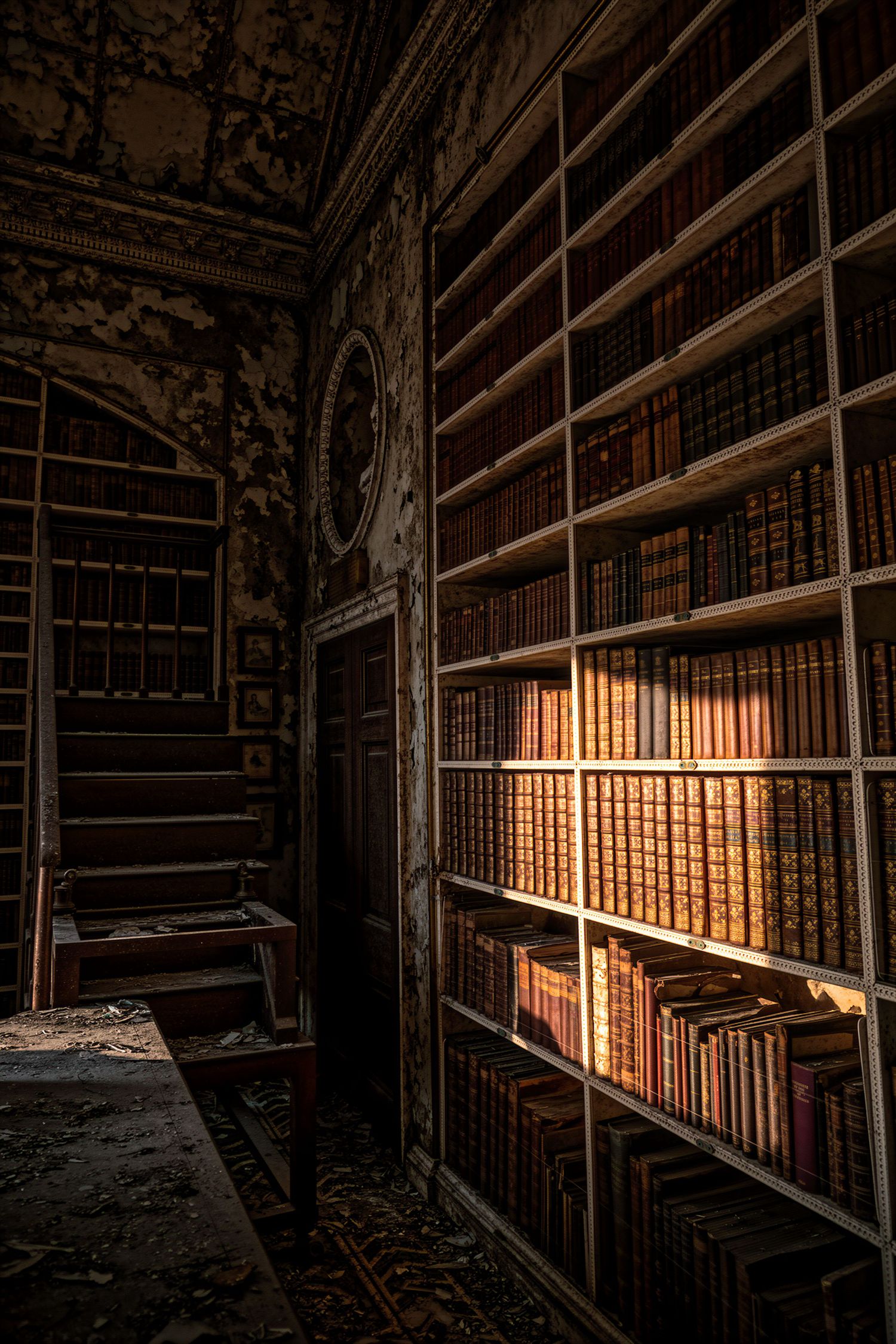
Row after row, the spines climb into a darkness the lamps can no longer reach — leather bindings, gilt lettering, titles no one has traced with a finger in decades. Only the lowest shelves still catch the light, and for a few hours each day, whatever comes through that broken window turns their gold tooling into something almost alive.
It's an odd kind of company, standing in a room like this. Thousands of voices, all silent at once, all still technically present. Every one of these books once answered a question for somebody. Now they simply wait to be asked one, in a room where the only visitor left is a camera.
I've felt this same pull in far plainer rooms — the specific weight a space carries once its purpose has quietly ended. I wrote about it more directly in The Weight of Interior Silence: absence, in these spaces, isn't an emptiness. It's a kind of density. This library holds it in its heaviest form yet — a whole room built entirely to hold thought, still holding it, with no one left to take any of it down.
A book doesn't go silent when it's closed. It goes silent when the last person who could have opened it stops coming back.
To the left, past a doorway hanging open on nothing, an oval frame still holds its place on the wall above a name I can no longer quite read — the paint has taken most of it back. Somewhere in this house, that inscription mattered enough to be carved and gilded. Now it's returning to plaster at exactly the same rate as everything else.
There's a particular dignity in objects that keep doing their job long after the job stopped mattering to anyone but them. I found it in The Ashington Miner's Lamp, a single numbered lamp that outlasted the entire industry built around it. These shelves do the same thing at a much larger scale — thousands of spines, still arranged, still upright, still doing the one job they were built for, in a room that has otherwise given up entirely.
It's part of why I keep photographing rooms like this rather than the grander, more obviously beautiful ones. I've tried to explain what draws me there before, and it always comes back to the same thing: not the ruin itself, but what the ruin still insists on doing. This shelf belongs to the wider Dark Abandonment collection — rooms I return to precisely because they haven't been tidied into a museum piece. They're just quietly, stubbornly, still themselves.
I stood there longer than I needed to, technically. Long enough that the smell stopped being "old house" and separated into its parts — damp plaster first, then something sweeter and drier underneath it: old paper, and the particular vanilla-ish scent that leather binding takes on after a century of nobody opening it. I didn't touch a single book. It felt like the one rule of the room, even though no one was left to enforce it.
Where the Light Still Reads isn't really about the books. It's about the very last job some things keep doing long after anyone stopped asking them to.
Where the Light Still Reads
Gallery-framed on premium cotton rag · Shipped worldwide · Certificate of authenticity