The Stone Remembers Him
The hands are the first thing.
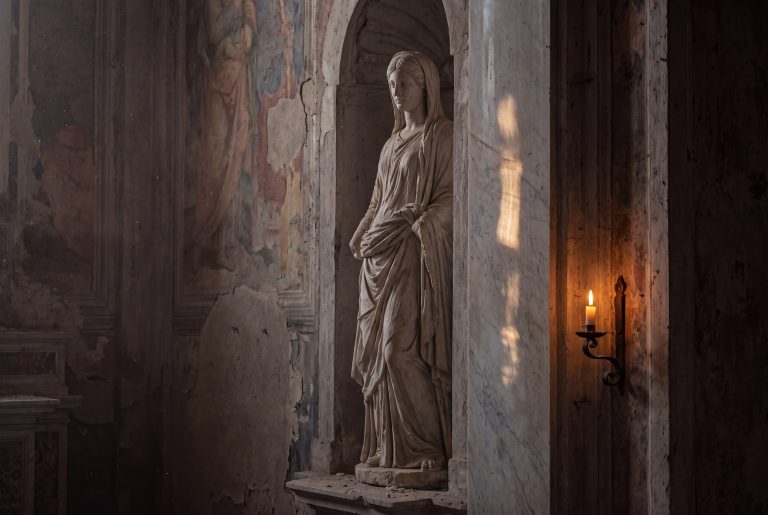
Folded across the chest with a precision that took a craftsman weeks to achieve — each finger separated, each knuckle present, the gesture of prayer held in perpetuity by a material that does not tire and does not forget. Stone hands. And yet not cold. Not inert. There is something in the angle of them, the slight curl of the thumb, that makes you feel the sculptor knew this man. Knew the way he held himself. Knew what his hands looked like when they were still.
I made this photograph in Liège Cathedral — Saint Paul’s, in Belgium — standing in the nave in the kind of cold that old stone holds even in spring. I have stood in front of many recumbent effigies over the years. The medieval ones are the ones that stay with me. Not because they are grander or better carved — though many are extraordinary — but because the intention behind them was different. They were not made to document. They were made to remember. The man who commissioned his own tomb monument in the twelfth or thirteenth century was not thinking about posterity in the abstract. He was thinking about specific people: his children, his congregation, those who would kneel beside this stone and say his name. The carving was an act of faith that the name would continue to be said.
He is not dead in this image. He is simply holding very still, the way stone has always held the things we cannot bear to lose.
What I find in these figures — and what this image made me feel standing in the cold of the nave with the light barely reaching the floor — is something closer to presence than to absence. The drapery has been carved to a softness that cloth itself rarely achieves. The face carries an expression I can only describe as composed: not peaceful, exactly, but finished. As though whatever needed resolving had been resolved. The vigil of stone is always this — the sense that the figure is not resting but waiting, patient in a way that only centuries can teach.
I think about the hands of the person who made this. The hours of cold chisel work in a draughty workshop. The decisions — ten thousand of them — about where to deepen a shadow, where to leave the surface smooth, where to let the stone breathe. That craftsman is as anonymous now as the figure is famous only within the walls of this one building. Both of them preserved here, together, in a collaboration neither one could have predicted would last this long. This is the territory of the life inside the stone — the idea that marble holds not just form but time itself, compressed and still.
This image belongs to Bone and Marble — a body of work concerned with the intersection of mortality and craft, with the long conversation between the human body and the stone that outlasts it. Each work in the collection approaches that conversation differently. This one approaches it through stillness so complete it becomes its own kind of sound.
Printed on premium cotton rag at 24×16 inches, the tonal range of this image — from the near-black of the shadow beneath the tomb chest to the cold grey-white of the carved face — holds in a way a screen cannot replicate. It is a work that asks for a certain quality of light in the room where it hangs. It changes with the afternoon. It rewards the returning glance. Some things in it will take months to find.
The Stone Remembers Him
Premium cotton rag print · Issued with a certificate of authenticity