The Hall of Stopped Things
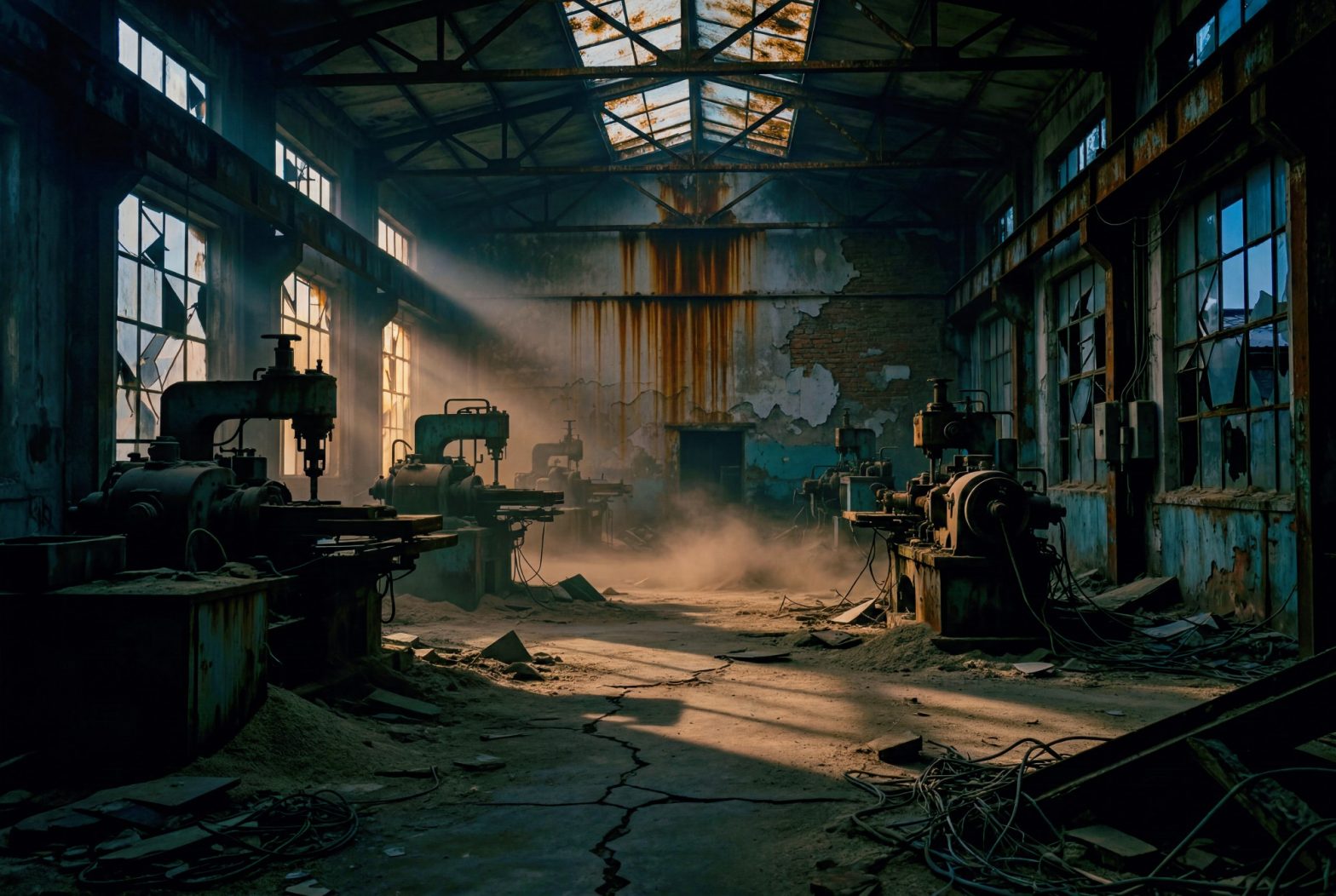
The light still moves. That is the first thing you notice. Everything else in this place stopped a long time ago — the lathes, the presses, the overhead lines of cable coiled like discarded rope on the floor. The clocks, if there were any, stopped too. But the light keeps coming through those high broken windows, crossing the floor in the same slow arc it always has, measuring hours that no one here is counting any more.
There is something about industrial dust that is unlike any other kind. It is not the soft grey dust of an unvisited room. It is iron dust. Stone dust. The ground-down residue of decades of work — metal meeting metal, cutting, shaping, forcing one material into the form of another. When the light catches it, as it does here, suspended in a column between the window frames, it looks almost like smoke from a fire that has only just gone out.
The machines were built to outlast the men who ran them. They were not built to stand in silence. That was never part of the plan.
I have walked through many abandoned spaces over thirty years. What I have learned is that industrial interiors hold grief differently from domestic ones. A forgotten kitchen carries the ghost of a meal, a conversation, a specific afternoon. A factory floor carries something larger and less personal — the weight of collective labour, of hundreds of lives spent in the same building, at the same task, without ever quite owning the work their hands produced. When that ends, the silence is not domestic. It is civic. It belongs to a whole community that no longer exists as it was.
The rust on the back wall is not damage. It is testimony. Iron oxidises because it remembers moisture, remembers the years when steam and coolant and the sweat of work kept this air alive. What you are seeing is iron in the process of returning to something older than the form it was given. It is the Iron Without Witness — the slow, patient dissolution of things built to serve, now serving only the record of their own existence.
This image rewards time. Not a glance across a room, but the longer kind of looking — the kind that finds the cable at the bottom of the frame and follows it, that notices the second shaft of light behind the first, that eventually settles on the back wall and reads what the rust has written there. It does not compete for attention. It waits. It has been waiting for years, and it will wait for as long as it takes. That quality is explored throughout my what draws me there writing — the instinct that pulls me into spaces others have finished with.
Hung in a room, it changes that room. Not loudly. Not immediately. But over time, at certain hours when the light falls at a particular angle, the image shifts — the dust seems to lift, the shadows deepen, and something that was once a photograph begins to feel like a doorway. A collector who lives with this work told me it took three weeks before they fully saw it. That is exactly how it should be. Some work reveals itself over time, and this is one of those. The Machinist’s Ghost found its way into a similar place — that line between record and feeling, between the factual and the felt.
This is the hall of stopped things. Every element in it — the machinery, the peeling wall, the cracked floor, the coiled wire — stopped at a different moment. The light alone refused.